You didn’t lift anything heavy today. You didn’t run a marathon. Maybe you didn’t even leave the house. And yet by 6 p.m. your brain feels like it’s been wrung out — foggy, short-tempered, unable to hold a single thought for more than a few seconds.
That’s not laziness, and it’s not in your head in the way you might think. It’s mental load, and unlike physical tiredness, it doesn’t announce itself with sore muscles. It shows up as forgetfulness, snapping at small things, staring at a to-do list you can’t seem to start, and lying awake at night while your body is exhausted but your mind won’t stop running.
Most advice on this topic treats “mental exhaustion” as one single problem with one list of fixes: turn off notifications, take a walk, get more sleep. Useful, but incomplete — because mental overload isn’t one thing. It’s usually a mix of four distinct types of load, and knowing which ones are hitting you hardest changes what actually helps.
The Four Types of Mental Load
1. Sensory load — the sheer volume of stimulation hitting your senses: notifications, background noise, multiple screens, open tabs, crowded spaces.
2. Decisional load — the accumulated weight of small choices: what to wear, what to eat, which message to answer first, what to prioritize. Each one is tiny. Fifty of them by noon is not.
3. Emotional load — stress you’re carrying that isn’t necessarily about anything happening right now: unresolved conversations, financial worry, the low hum of “am I doing enough.”
4. Informational load — the raw amount of content your brain processes daily: news, social feeds, messages, opinions, advice (including, ironically, productivity advice).
Most days you’re dealing with some combination of all four. A single “turn off your phone” tip helps with sensory and informational load, but does nothing for the twelve decisions still sitting in your head or the unresolved tension from a conversation this morning. That’s usually why generic advice feels like it “doesn’t work” — it’s aimed at only one of the four levers.
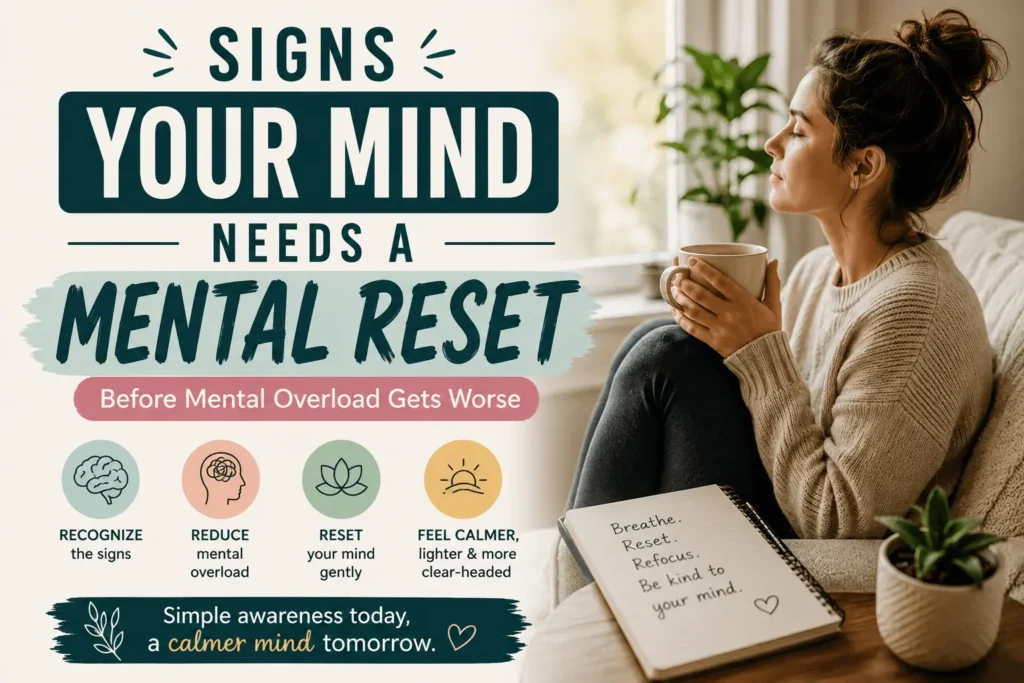
The Signs Your Mind Is Overloaded
Physical tiredness is easy to notice — you rest. Mental overload is sneakier, because you can still function while it’s happening. Here’s what it typically looks like, grouped by which type of load is usually driving it:
Signs of sensory/informational overload
– You feel mentally tired even after a full night’s sleep
– You reach for your phone the instant a moment goes quiet
– Screen time leaves you feeling more drained than relaxed, even though it felt like “resting” at the time
– You struggle to focus, rereading the same sentence or losing track of conversations
Signs of decisional overload
– Small tasks — replying to a message, picking dinner, choosing what to wear — suddenly feel disproportionately hard
– You keep delaying simple decisions, not because they’re difficult, but because you have nothing left to decide with
– You default to “whatever’s easiest” even on things you’d normally care about
Signs of emotional overload
– You’re irritated by things that wouldn’t normally bother you
– You feel emotionally flat, disconnected, or numb rather than sad or angry — just… less
– You feel guilty resting, like you haven’t “earned” a break yet
Signs your mind won’t switch off
– Your thoughts keep replaying conversations or jumping to unfinished tasks, even during downtime
– Sleep doesn’t feel restful — you fall asleep tired but wake up just as foggy
– Quiet moments feel uncomfortable rather than calming, so you fill them immediately
If several of these sound familiar, the fix isn’t “try harder” or “be more productive.” It’s recovery — and which recovery habit helps depends on which type of load is hitting you hardest.
What Actually Helps (Matched to the Type of Load)
If sensory/informational load is the problem
– Create one genuinely offline stretch each day. Not “less scrolling” — an actual window (even 20–30 minutes) with no screen, no podcast, no background noise. Silence is uncomfortable at first if you’re not used to it; that discomfort fades within a few days.
– Turn off non-essential notifications, not just silence your phone. A silenced phone still pulls your attention every time the screen lights up.
– Take single-purpose breaks. A walk without your phone does more for sensory overload than a walk while listening to a podcast — the goal is input reduction, not just movement.
If decisional load is the problem
– Pre-decide the small stuff. Repeat outfits, plan meals for the week, set a fixed time to check messages instead of reacting all day. Every decision you remove from a normal day is mental energy saved for the ones that matter.
– Make important decisions earlier in the day, when your decision-making capacity is highest. Save low-stakes choices for the afternoon, when you’re already running on less.
– Aim for “good enough,” not optimal, on anything reversible. Perfectionism on small decisions is one of the biggest hidden drains — deciding *well enough, quickly* preserves far more energy than deciding *perfectly, slowly*.
If emotional load is the problem
– Write it down before bed. Getting a worry out of your head and onto paper measurably reduces the mental “loop” — you don’t need to solve it, just externalize it so your brain stops rehearsing it.
– Name what’s actually bothering you. Vague unease (“I just feel off”) is harder to resolve than a specific worry (“I haven’t dealt with X”). Even a rough label reduces the load.
– Stop treating rest as something to earn. If you only allow yourself to slow down after everything is finished, you’ll never actually slow down — there’s always something unfinished.
If your mind won’t switch off
– Build a 30-minute wind-down before sleep with no screens and no problem-solving — reading, stretching, or just sitting quietly. Your brain needs a runway, not an abrupt stop.
– Do a five-minute “brain dump” each evening: write down tomorrow’s top three priorities so your mind doesn’t have to hold onto them overnight.
– Notice when quiet feels uncomfortable. That discomfort is often the clearest sign recovery is overdue — an overstimulated brain resists the very stillness it needs most.
A Real Example
Sarah, a hybrid worker, assumed she’d simply become less motivated — she couldn’t focus the way she used to, and by evening she felt wiped out despite not doing anything physically demanding. Looking closer, her day was a mix of all four load types: constant Slack notifications (sensory), dozens of small work decisions before lunch (decisional), background anxiety about an unresolved team conflict (emotional), and hours of scrolling news and social media that felt like rest but wasn’t (informational).
She didn’t overhaul her life. She made three changes: silenced non-essential notifications, took a 15-minute walk without her phone each afternoon, and stopped screens 30 minutes before bed. Within two weeks she was focusing longer, felt calmer by evening, and — the part that surprised her most — actually looked forward to the quiet 30 minutes before bed instead of filling it with her phone out of habit.
Her problem was never motivation. It was that she was trying to run a decisional, sensory, and emotional deficit all at once, every single day, with zero deliberate recovery built in.
How Long Does Recovery Take?
Mental overload usually builds over weeks, not days — which means it doesn’t reverse overnight either. Most people notice a meaningful difference within 1–2 weeks of consistently reducing even one type of load (start with whichever category matched the most signs above). Full recovery from a longer stretch of chronic overload — the kind that’s been building for months — can take 4–6 weeks of consistent habits. The goal isn’t a single perfect day; it’s fewer overloaded days than overloaded ones, trending in the right direction.
FAQ
What’s the difference between mental exhaustion and burnout?
Mental exhaustion is the daily, recoverable version — you feel drained but bounce back with rest, sleep, and lower stimulation. Burnout is what happens when that exhaustion goes unaddressed for months: it becomes chronic, affects your sense of competence and motivation, and typically needs more than a few quiet evenings to resolve. Think of the signs above as an early warning system — catching them early is what prevents burnout in the first place.
Can mental exhaustion happen even on “easy” days?
Yes — this is the most misunderstood part of mental load. Decisional and informational load don’t require physical effort or a demanding schedule. A day spent scrolling, half-working, and making dozens of small unremarkable choices can be just as draining as a genuinely hard one, because your brain doesn’t distinguish between “important” processing and “trivial” processing — it just adds up the total volume.
Is it normal to feel guilty about resting?
Very common, but worth examining directly. Guilt about rest usually comes from treating recovery as something you earn after finishing everything — which means it never actually arrives, since there’s always something unfinished. Rest that improves your focus and mood the next day isn’t wasted time; it’s what makes the rest of your week function.
How do I know which type of load is affecting me most?
Look back at the four sign categories above and notice which one you nodded along to the most. Most people have one dominant type (often decisional or informational) with a smaller amount of the others mixed in. Start your recovery habits there — matching the fix to the actual cause works far better than applying generic advice across the board.
Does screen time always cause mental exhaustion?
Not inherently — it depends on what kind of screen time and how much control you have over it. Passive, single-focus screen time (one show, deliberately chosen) is far less draining than reactive, multi-source screen time (notifications, multiple apps, constant switching). The volume of *switching* matters more than the total minutes.
Have you noticed which type of mental load hits you hardest — sensory, decisional, emotional, or informational? Related: How to Reduce Digital Overload if sensory/screen load is your biggest driver, or How to Take a Break Without Feeling Guilty if the guilt-around-rest pattern sounds familiar.