Quick Answer
An emergency information binder is a secure, organized collection of your family’s most important information, including emergency contacts, medical details, insurance policies, and copies of essential documents. Creating one helps your family respond more quickly during unexpected situations and ensures critical information is always easy to find.
Is This You?
Imagine there’s a medical emergency in your family.
Someone needs to know:
- Your medications
- Emergency contacts
- Insurance information
- Blood type
- Children’s medical details
- Your doctor’s phone number
Would everything be easy to find?
Or would family members have to search through drawers, filing cabinets, emails, and old folders while already feeling overwhelmed?
Unfortunately, that’s the reality for many households.
Important information is often scattered across different places, making emergencies even more stressful than they need to be.
An emergency information binder solves this problem by keeping your family’s essential information together in one organized place.
It’s not just for natural disasters or major emergencies. It can also be incredibly helpful during hospital visits, unexpected travel, home repairs, or any situation where quick access to important information matters.
By the end of this guide, you’ll know exactly what to include, how to organize it, and how to keep it updated using a simple system that works for families of all sizes.
At a Glance
| Topic | Details |
|---|---|
| Difficulty | Easy |
| Setup Time | 2–3 hours |
| Maintenance | 30 minutes once a year |
| Best For | Families, couples, homeowners, renters, caregivers |
| Framework | SmartHelpHub READY Framework |
| Goal | Keep essential family information organized and easy to access |
Who Should Have an Emergency Information Binder?
Many people assume emergency binders are only for large families or older adults.
In reality, almost everyone can benefit from having one.
This guide is especially helpful for:
Parents
Keeping children’s medical information, school contacts, and emergency instructions together can save valuable time when every minute counts.
Couples
A shared binder ensures both partners know where to find insurance details, important contacts, and household information if one person is unavailable.
Seniors
Having medical records, medication lists, and emergency contacts organized makes it easier for caregivers or family members to provide assistance when needed.
Caregivers
If you help care for a child, aging parent, or someone with ongoing medical needs, an emergency binder can keep essential information in one place.
Homeowners and Renters
Property information, insurance policies, utility contacts, and emergency procedures can all be stored together for quick reference.
Even if you live alone, an emergency information binder can make it easier for trusted family members or friends to help if an unexpected situation arises.
Why This Guide Is Different
Most articles about emergency binders focus only on documents.
This guide goes beyond paperwork.
You’ll learn how to organize:
- Emergency contacts
- Medical information
- Insurance details
- Household information
- Children’s information
- Pet information
- Emergency plans
- Essential document copies
Instead of simply collecting papers, you’ll build a practical family resource that can be updated year after year.
Table of Contents
- What Is an Emergency Information Binder?
- Why Every Family Should Have One
- What to Include in Your Binder
- The SmartHelpHub READY Framework
- How to Organize Each Section
- Physical vs Digital Emergency Binder
- Where to Store Your Binder
- Common Mistakes to Avoid
- Annual Review Checklist
- Frequently Asked Questions
- Final Thoughts
Creating an emergency binder is much easier when your essential paperwork is already organized. If you haven’t done that yet, start with How to Organize Important Documents at Home (Without Losing Them) to build a simple filing system before assembling your emergency binder.
What Is an Emergency Information Binder?
An emergency information binder is a single, organized place where you keep the most important information your family may need during an unexpected situation.
Unlike a regular filing system that stores all your paperwork, an emergency binder contains only the most essential information that someone might need quickly.
Think of it as your family’s emergency reference guide.
Instead of searching through multiple drawers, digital folders, emails, or filing cabinets, everything important is gathered in one easy-to-access location.
An emergency information binder can help during situations such as:
- Medical emergencies
- Natural disasters
- House fires
- Sudden hospital visits
- Unexpected travel
- Temporary evacuation
- Family emergencies
- Caring for children or elderly relatives
The goal isn’t to prepare for the worst—it’s to make stressful situations a little easier by ensuring important information is readily available.
Why Every Family Should Have One
Emergencies rarely happen when we’re prepared.
When stress levels are high, even simple tasks like finding an insurance policy number or contacting a doctor can feel overwhelming.
An emergency information binder helps by keeping everything organized before you need it.
Benefits of an Emergency Binder
✔ Reduces stress during emergencies.
✔ Saves valuable time.
✔ Helps trusted family members access important information.
✔ Prevents important details from being forgotten.
✔ Keeps medical and insurance information together.
✔ Makes emergency planning easier.
✔ Provides peace of mind.
Even if you never experience a major emergency, having an organized emergency binder is one of the simplest ways to prepare for life’s unexpected moments.
Emergency Binder vs Document Organizer
Many people confuse these two.
They serve different purposes.
| Document Organizer | Emergency Information Binder |
|---|---|
| Stores all important paperwork | Stores only essential emergency information |
| Long-term document storage | Quick emergency reference |
| Filing system | Emergency planning system |
| Organized by document type | Organized by emergency needs |
| Used occasionally | Used during urgent situations |
Your document organizer supports your emergency binder.
It doesn’t replace it.
Smart Tip: Think of your document organizer as your complete library and your emergency binder as your “quick-reference guide.” The binder contains only the information you’ll want to find immediately during an emergency.
What Should Be Included?
One of the biggest mistakes people make is adding too much information.
Your emergency binder should stay focused on the essentials.
Below are the key sections every household should consider.
1. Family Information
Start with basic household information.
Include:
- Full names
- Dates of birth
- Home address
- Mobile phone numbers
- Email addresses
- Recent family photo (optional)
This provides a quick overview if someone else needs to use the binder.
2. Emergency Contacts
Create one page that lists the people your family may need to contact quickly.
Examples include:
Family
- Parents
- Children
- Siblings
- Close relatives
Medical
- Family doctor
- Pediatrician
- Dentist
- Pharmacy
Home
- Trusted neighbor
- Landlord (if renting)
- Property manager
Insurance
- Health insurance
- Home insurance
- Vehicle insurance
Other
- Employer
- School
- Childcare provider
- Veterinarian
Keep contact information updated whenever phone numbers or addresses change.
3. Medical Information
Medical information can save valuable time during emergencies.
Include:
- Current medications
- Allergies
- Blood type (if known)
- Chronic medical conditions
- Recent surgeries
- Medical devices
- Emergency medical contacts
- Health insurance details
Create separate pages for each family member.
This makes the information much easier to locate.
4. Insurance Information
Instead of storing every insurance document, create a summary page.
Include:
- Insurance company
- Policy number
- Customer support phone number
- Agent’s contact information
- Renewal date
You can also note where the full policy documents are stored.
5. Home Information
Helpful household information includes:
- Utility companies
- Electricity provider
- Water provider
- Gas provider
- Internet provider
- Home alarm company (if applicable)
- Trusted repair contacts
- Spare key location (only if appropriate and secure)
This information can be especially useful if another trusted adult needs to manage your home during an emergency.
6. Children’s Information
If you have children, dedicate a section to their essential information.
Include:
- School name
- Teacher’s name
- Emergency pickup contacts
- Pediatrician
- Allergies
- Current medications
- Health insurance details
Having this information in one place can make school or medical emergencies much easier to manage.
7. Pet Information
Pets are often forgotten during emergency planning.
Include:
- Pet’s name
- Species and breed
- Microchip number
- Veterinarian
- Medications
- Feeding instructions
- Emergency caregiver
This helps ensure your pets receive proper care if you’re temporarily unavailable.
8. Essential Document Copies
Your emergency binder should not replace your document organizer.
Instead, include copies of only the most important records, such as:
- Identification documents
- Health insurance cards
- Property insurance summary
- Vehicle insurance summary
- Emergency contact list
Keep original documents stored securely elsewhere and update these copies whenever important information changes.
Emergency Information Binder Checklist
| Section | Included |
|---|---|
| Family Information | □ |
| Emergency Contacts | □ |
| Medical Information | □ |
| Insurance Summary | □ |
| Home Information | □ |
| Children’s Information | □ |
| Pet Information | □ |
| Copies of Essential Documents | □ |
You can print this checklist and use it as you build your binder.
The SmartHelpHub READY Framework
Gathering information is only the first step. The real challenge is keeping your emergency binder organized and useful over time.
To make the process simple, use the READY Framework, a five-step system designed to help you build and maintain an emergency information binder without feeling overwhelmed.
R – Record Your Essential Information
Start by collecting the information your family would need immediately during an emergency.
This includes:
- Family member details
- Emergency contacts
- Medical information
- Insurance summaries
- Household information
- Children’s and pets’ details
Don’t worry about making everything perfect. Begin with the essentials and improve your binder over time.
Smart Tip: Set aside 20–30 minutes for each section instead of trying to complete everything in one sitting.
E – Emergency Contacts First
Your emergency contact page should be one of the first sections in the binder.
Include contacts for:
- Close family members
- Trusted friends or neighbors
- Family doctor
- Pediatrician
- Dentist
- Pharmacy
- School or childcare
- Veterinarian
- Insurance providers
Arrange them by priority so the most important contacts are listed first.
| Contact | Name | Phone | Notes |
|---|---|---|---|
| Primary Family Contact | |||
| Secondary Contact | |||
| Family Doctor | |||
| Emergency Vet |
A – Accessible but Secure
Your emergency binder should be easy to locate, but it shouldn’t be left where visitors or strangers can access sensitive information.
Good storage locations include:
- A labeled drawer in your home office
- A fire-resistant document safe
- A locked filing cabinet
Tell at least one trusted family member where the binder is stored and how to access it if needed.
If you create a digital version, protect it with strong passwords and enable two-factor authentication where possible.
D – Document Only What Matters
Avoid turning your emergency binder into a bulky filing cabinet.
Instead of including every document you own, focus on summaries and copies of the most important records.
For example:
- Insurance summary pages instead of full policy booklets
- A medication list instead of every prescription receipt
- A copy of identification rather than every supporting document
This keeps the binder practical and easy to navigate during stressful situations.
Y – Yearly Review
An emergency binder is only useful if the information is current.
Review it at least once a year or whenever there is a significant life change, such as:
- Moving to a new home
- Changing phone numbers
- Updating insurance policies
- Starting or stopping medications
- Marriage or divorce
- Birth or adoption
- A new school or employer
A yearly review usually takes less than an hour but ensures your binder stays accurate when you need it most.
Example Binder Structure
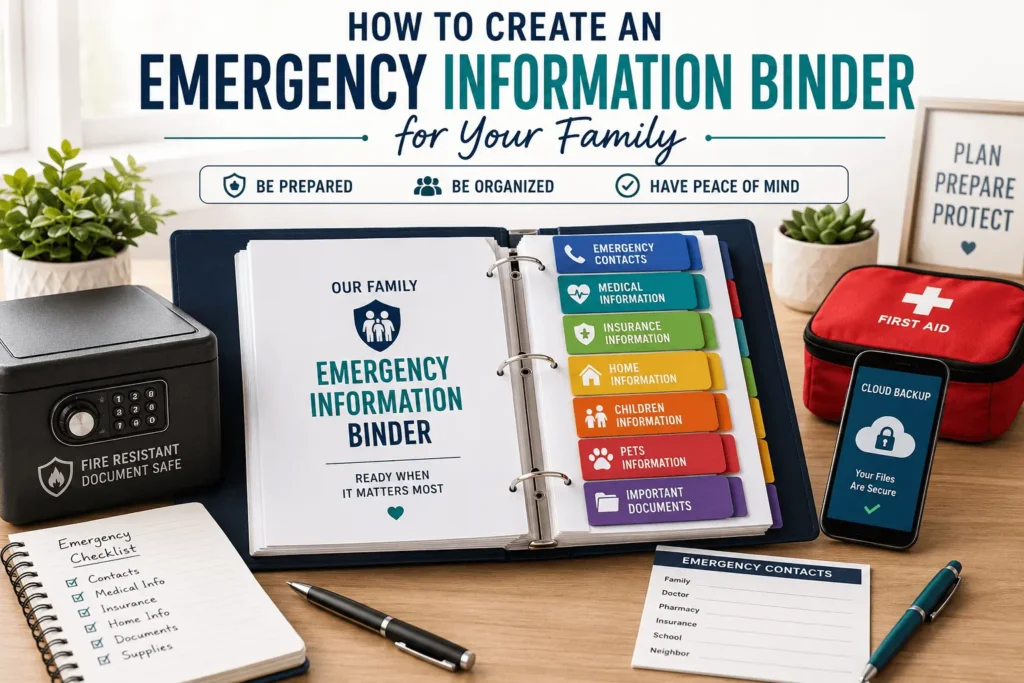
Here’s a simple way to organize your binder:
- Family Overview
- Emergency Contacts
- Medical Information
- Insurance Information
- Home & Utilities
- Children’s Information
- Pet Information
- Emergency Plans
- Copies of Essential Documents
- Annual Review Checklist
Use clearly labeled divider tabs so each section is easy to find.
Common Questions While Building Your Binder
Should I include original documents?
No. Store original documents in a secure location, such as a safe or locked filing cabinet. Your emergency binder should contain summaries or copies that are easy to reference.
Should I make more than one copy?
If appropriate for your household, consider one primary binder at home and a secure digital backup. This provides access if the physical binder is damaged or unavailable.
Who should know about it?
Only trusted adults who may need to help during an emergency, such as a spouse, adult child, caregiver, or another designated family member.
Physical vs. Digital Emergency Binder
One common question is whether your emergency information binder should be physical, digital, or both.
The best solution for most households is a hybrid approach—keeping a printed binder for quick access while maintaining a secure digital backup that can be accessed if you’re away from home.
| Physical Binder | Digital Binder |
|---|---|
| Easy to use during power or internet outages | Accessible from anywhere with permission |
| No technology required | Easy to update without reprinting |
| Ideal for first responders or family members | Can be securely backed up in the cloud |
| Doesn’t rely on passwords or devices | Can be encrypted and password-protected |
Neither option is perfect on its own. Combining both provides convenience and extra protection.
Smart Tip: Store digital files in clearly labeled folders and keep them updated whenever you make changes to your printed binder.
Where Should You Store Your Emergency Binder?
Your binder should be stored where trusted family members can find it quickly, but it shouldn’t be left in plain sight where sensitive information could be exposed.
Good storage locations include:
- A fire-resistant document safe
- A locked filing cabinet
- A dedicated drawer in your home office
- A secure home safe
Avoid storing it in places that are difficult to access during an emergency, such as an attic, basement, or packed storage box.
If you keep a digital version, store it in a secure cloud service or encrypted external drive and make sure at least one trusted person knows how to access it if necessary.
Who Should Know About Your Binder?
An emergency binder only helps if the right people know it exists.
Consider informing:
- Your spouse or partner
- An adult child
- A trusted relative
- A caregiver
- Someone listed as your emergency contact
You don’t need to share every detail immediately, but these individuals should know:
- Where the binder is stored
- How to access it if needed
- When it was last updated
Keeping this information private while ensuring trusted people can locate it strikes the right balance between security and preparedness.
Keep Sensitive Information Secure
Because an emergency binder contains personal details, protecting it is just as important as creating it.
Here are a few simple security practices:
- Avoid writing online banking passwords or PINs in the binder.
- Don’t include unnecessary financial details.
- Keep copies of identification documents only if they’re truly needed.
- Lock the binder away when it’s not being used.
- Password-protect digital versions.
- Review who has access whenever your circumstances change.
Your goal is to make important information available during an emergency without increasing the risk of identity theft or unauthorized access.
Common Mistakes to Avoid
Even a well-intentioned emergency binder can become less useful if it’s not maintained properly.
1. Including Too Much Information
A binder isn’t meant to replace your filing cabinet.
Focus on the information someone would need quickly during an emergency.
2. Forgetting to Update It
Phone numbers, medications, insurance policies, and emergency contacts can change over time.
An outdated binder may cause confusion when accurate information matters most.
3. Storing It Somewhere Nobody Knows
If only one person knows where the binder is, it may not be helpful when they’re unavailable.
Tell at least one trusted adult where it’s stored.
4. Keeping Only a Digital Copy
Power outages, damaged devices, or forgotten passwords can make digital files difficult to access.
A printed version provides a reliable backup.
5. Including Passwords or PINs
Instead of recording sensitive login credentials, note where your password manager or secure records can be accessed by an authorized person if appropriate.
6. Never Testing Your System
Once your binder is complete, ask yourself:
“If an emergency happened today, could someone unfamiliar with my paperwork find what they need within five minutes?”
If the answer is no, simplify the binder until it’s easy to navigate.
Annual Emergency Binder Review Checklist
Set a recurring reminder once a year to review your binder.
Use this checklist:
| Review Task | Complete |
|---|---|
| Verify emergency contact numbers | □ |
| Update medications and allergies | □ |
| Check insurance policy details | □ |
| Review children’s school information | □ |
| Update pet information | □ |
| Replace outdated document copies | □ |
| Test digital backup access | □ |
| Confirm trusted family members know where the binder is stored | □ |
A yearly review usually takes less than an hour and helps ensure your information stays accurate.
Reality Check
Creating an emergency information binder isn’t about expecting something bad to happen.
It’s about making life a little easier if it ever does.
You hope you’ll never need it, but if an unexpected situation arises, having organized information can reduce stress, save valuable time, and help your family make informed decisions when they matter most.
An emergency binder is just one part of keeping your personal life organized. If you’re looking to create a complete system for managing documents, responsibilities, and everyday tasks, read How to Build a Personal Life Management System That Actually Works.
Frequently Asked Questions
What is an emergency information binder?
An emergency information binder is a single, organized place that contains your family’s essential information, such as emergency contacts, medical details, insurance summaries, and copies of important documents. It helps trusted family members quickly find the information they need during an unexpected situation.
What should I include in an emergency information binder?
A well-organized emergency binder typically includes:
Family information
Emergency contacts
Medical information
Insurance summaries
Home information
Children’s information (if applicable)
Pet information (if applicable)
Copies of essential documents
An annual review checklistCustomize the contents based on your family’s needs.
Where should I keep my emergency information binder?
Store it in a secure but easily accessible location, such as a fire-resistant safe, locked filing cabinet, or dedicated home office drawer. Make sure at least one trusted family member knows where it is and how to access it.
Should I include original documents?
No. Original documents should remain in a secure location. Your emergency binder should contain copies or summaries that are easy to access during an emergency.
Is a digital emergency binder enough?
A digital binder is helpful, but it’s best used alongside a printed version. A hybrid system ensures you can still access important information during internet outages, device failures, or other unexpected situations.
How often should I update my emergency binder?
Review your binder at least once a year or whenever significant life changes occur, such as moving, changing insurance providers, updating medications, or adding a new family member.
Should I include passwords in my emergency binder?
No. Avoid writing passwords, PINs, or security codes in your binder. Instead, note where your secure password manager or other protected records can be accessed by an authorized person if necessary.
Can a single person benefit from an emergency binder?
Absolutely. Whether you live alone, with roommates, or with family, an emergency binder can help trusted contacts access important information if you’re unable to communicate during an emergency.
Key Takeaways
✔ An emergency information binder keeps your family’s most important information together in one place.
✔ Focus on summaries and essential information instead of storing every document.
✔ Use the READY Framework to build and maintain your binder step by step.
✔ Store your binder securely while ensuring trusted family members know where to find it.
✔ Review and update it annually so the information stays accurate and useful.
Final Thoughts
No one likes to think about emergencies, but being prepared can make challenging situations far less stressful.
Creating an emergency information binder isn’t about expecting the worst—it’s about giving yourself and your loved ones confidence that important information will be easy to find when it’s needed most.
You don’t have to complete everything in a single afternoon. Start with the basics, add information gradually, and review it once a year. Small steps today can save valuable time and reduce unnecessary stress in the future.
By following the READY Framework, you’ll have a practical system that helps protect your family, supports informed decision-making, and provides peace of mind for years to come.
As your household grows and changes, your emergency binder can grow with it, becoming an essential part of your family’s overall organization and preparedness.