Quick Answer
Motivation is helpful, but it’s unreliable. Some days you feel excited to work toward your goals, and other days you don’t. That’s completely normal. The key to long-term consistency isn’t finding endless motivation—it’s building simple systems that make taking action easier, even when you don’t feel like it. In this guide, you’ll learn the Smart Systems Loop, a practical framework for creating repeatable daily systems that help you stay consistent without depending on willpower alone.
Is This You?
Have you ever experienced something like this?
- You start every Monday feeling motivated.
- You buy a new planner or download another productivity app.
- You promise yourself, “This time I’ll stay consistent.”
- A few days later, life gets busy.
- Your routine disappears.
- You feel frustrated and decide to start again next week.
If this cycle feels familiar, you’re not alone.
Most people don’t struggle because they lack ambition.
They struggle because they’re depending on something that naturally changes every day:
Motivation.
Some mornings you’ll wake up feeling energized.
Other mornings you’ll feel tired, stressed, or distracted.
If your progress depends on how motivated you feel each day, consistency becomes almost impossible.
The good news is that successful people don’t stay consistent because they’re always motivated.
They stay consistent because they’ve built systems that make taking action easier.
That’s exactly what you’ll learn in this guide.
At a Glance
Best For
- Anyone who struggles to stay consistent
- Students
- Busy professionals
- Parents
- Entrepreneurs
- People building new habits
What You’ll Learn
✔ Why motivation naturally comes and goes
✔ Why systems outperform willpower
✔ How to create simple daily systems
✔ The Smart Systems Loop
✔ Common mistakes that keep people inconsistent
Take Action Today
Before reading further, answer one question:
What’s one goal you’ve started several times but never managed to stick with?
Keep that goal in mind throughout this guide.
You’ll use it to build your first personal system before you finish reading.
5-Minute Reset
Before continuing, spend just five minutes creating a better environment for learning.
- Put your phone on silent.
- Close unnecessary browser tabs.
- Take three slow, deep breaths.
- Grab a notebook or open a blank document.
- Write down one goal you’d genuinely like to stay consistent with.
You don’t need a detailed plan yet.
You only need one goal.
We’ll build the system together as you move through this guide.
Why This Guide Is Different
Many productivity articles focus on increasing motivation.
They suggest watching inspirational videos, reading quotes, or waiting until you feel inspired.
While those things may provide a temporary boost, they rarely create lasting change.
This guide takes a different approach.
Instead of asking:
“How can I become more motivated?”
We’ll ask:
“How can I make taking action easier?”
That small shift changes everything.
When your daily actions become simple, predictable, and repeatable, you no longer need to rely on motivation as often.
Your systems begin doing the heavy lifting.
Why Systems Matter More Than Motivation
Imagine two people who both want to become healthier.
The first person waits until they feel motivated to exercise.
Some weeks they work out every day.
Other weeks they do nothing.
The second person lays out their workout clothes every night, exercises for just fifteen minutes after waking up, and tracks each session on a calendar.
Neither person is motivated every day.
The difference is that one has built a system.
Systems reduce the number of decisions you have to make.
Instead of asking yourself,
“Should I exercise today?”
your system quietly answers,
“This is simply what I do after breakfast.”
The less energy you spend deciding, the easier it becomes to stay consistent.
Common Misconceptions About Motivation
Many people believe:
- Successful people are always motivated.
- Discipline means never struggling.
- Missing one day means you’ve failed.
- Big changes require big actions.
None of these beliefs are true.
Successful people also have unmotivated days.
The difference is that they rely less on emotion and more on repeatable routines and systems.
Consistency isn’t about feeling inspired every morning.
It’s about making it easy to take the next small step.
Real-Life Scenario
Meet Daniel
Daniel wanted to read more books.
Every Sunday he promised himself he would read for an hour every evening.
By Wednesday, he had stopped.
Instead of trying harder, Daniel changed his approach.
He placed one book on his pillow every morning before leaving for work.
At night, he only needed to read two pages before going to sleep.
Some evenings he stopped after two pages.
Other evenings he kept reading for thirty minutes.
The important part wasn’t how much he read.
It was that the system made starting easy.
Months later, Daniel had read more books than he had during the previous two years.
His success didn’t come from stronger motivation.
It came from a better system.
Key Insight
Motivation helps you begin.
Systems help you continue.
The sooner you stop relying on temporary feelings and start building reliable daily systems, the easier consistency becomes.
Start Here
Think about one goal you’ve been struggling with.
Don’t ask:
“How can I become more motivated?”
Instead ask:
“What small system would make this goal easier to repeat every day?”
That question is the foundation of lasting progress.
Everything else in this guide builds on that idea.
Why Motivation Doesn’t Last
In Short: Motivation is a powerful starting point, but it’s not designed to stay at the same level every day. Your emotions, energy, environment, and responsibilities constantly change. That’s why relying on motivation alone often leads to inconsistency.
Think about the last time you felt inspired to make a positive change.
Maybe you wanted to:
- Start exercising.
- Wake up earlier.
- Eat healthier.
- Save more money.
- Read every day.
- Learn a new skill.
At first, everything felt exciting.
You created a plan.
Bought new supplies.
Set ambitious goals.
For a few days—or maybe even a few weeks—you stayed consistent.
Then life happened.
Work became busy.
You slept poorly.
Your schedule changed.
Unexpected responsibilities appeared.
Gradually, your motivation faded.
This isn’t a personal failure.
It’s simply how motivation works.
Motivation is an emotion, and emotions naturally rise and fall.
Motivation Is Temporary
Many people believe successful people are motivated all the time.
In reality, they’re not.
Professional athletes don’t always feel like training.
Writers don’t always feel inspired.
Business owners don’t wake up excited every morning.
Students don’t always feel like studying.
The difference isn’t that they never lose motivation.
The difference is that they don’t depend on it.
Instead, they rely on routines, systems, and habits that make taking action easier—even on difficult days.
Real-Life Scenario
Emma’s Fitness Goal
Emma decided she wanted to become healthier.
The first week was easy.
She exercised every morning and prepared healthy meals.
By the second week, work became stressful.
She skipped one workout.
Then another.
Soon she felt like she had “failed.”
The problem wasn’t that Emma lacked determination.
The problem was that her plan depended entirely on feeling motivated.
Without a system to support her, consistency became difficult.
Life Is Unpredictable
One reason motivation fades is that life constantly changes.
Some days you have:
- Plenty of energy.
- Free time.
- A positive mindset.
Other days you may experience:
- Poor sleep.
- Tight deadlines.
- Family responsibilities.
- Illness.
- Stress.
- Unexpected interruptions.
If your progress depends on perfect conditions, you’ll make progress only when life feels easy.
Unfortunately, life rarely stays that predictable.
Systems are valuable because they continue working even when circumstances aren’t ideal.
Motivation Creates Too Many Daily Decisions
Every time you ask yourself,
“Should I do this today?”
you’re using mental energy.
Should I exercise?
Should I study?
Should I organize my desk?
Should I work on my goal?
Making the same decision every day becomes exhausting.
Learning how to Reduce Decision Fatigue in Daily Life can help you understand why removing unnecessary decisions often makes consistency much easier.
Instead of debating whether to take action, a simple system turns important behaviors into part of your normal routine.
Key Insight
The fewer decisions you have to make, the easier it becomes to stay consistent.
That’s one of the biggest advantages of building systems.
Motivation Depends on Feelings
Imagine only brushing your teeth when you felt motivated.
It would probably happen far less often.
You brush your teeth because it’s part of your routine.
The decision has already been made.
Systems work the same way.
Instead of asking,
“Do I feel like doing this?”
your system quietly answers,
“This is what I normally do.”
That shift removes unnecessary mental resistance.
The Motivation Trap
One of the biggest productivity myths is believing:
“I’ll start when I feel more motivated.”
Unfortunately, waiting usually creates the opposite effect.
The longer you delay taking action, the harder it often feels to begin.
Action creates momentum.
Momentum builds confidence.
Confidence often increases motivation.
In other words, motivation is frequently the result of taking action—not the cause of it.
Real-Life Scenario
Liam’s Writing Habit
Liam wanted to write every day.
Instead of waiting until he felt creative, he committed to writing for just five minutes after breakfast.
Some mornings he stopped after five minutes.
Other mornings he wrote for nearly an hour.
The important part wasn’t the length of each session.
It was that he showed up consistently.
Over time, writing became part of his daily rhythm rather than something that depended on inspiration.
Stop Waiting for the Perfect Time
Many people postpone important goals because they believe a better time is coming.
They tell themselves:
- I’ll start next Monday.
- I’ll begin after the holidays.
- I’ll wait until work becomes less busy.
- I’ll start when I have more energy.
But perfect conditions rarely exist.
Systems don’t require perfect timing.
They work because they fit into ordinary, imperfect days.
Even a tiny action completed consistently creates more progress than a perfect plan that never begins.
SmartHelpHub Tip
When you catch yourself saying,
“I’ll do it when I feel motivated,”
replace it with:
“What’s the smallest action I can complete today?”
Small actions keep your system alive.
Waiting for motivation often keeps it stuck.
Take Action
Think about one goal you’ve been postponing.
Now answer these questions:
- What decision do I repeat every day?
- How could I remove that decision?
- What tiny action could become automatic instead?
Don’t worry about creating the perfect system yet.
In the next section, you’ll learn exactly how to build one using the Smart Systems Loop.
The Smart Systems Loop
In Short: Most people believe motivation creates action. In reality, lasting progress comes from building simple systems that make action easier. The Smart Systems Loop shows how small, repeatable actions lead to consistency, confidence, and eventually, stronger motivation.
Many people think success follows a simple pattern:
Motivation → Action → Results
At first glance, this seems logical.
You feel motivated.
You take action.
You achieve your goal.
The problem is that motivation isn’t always available.
Some days you’ll wake up feeling excited.
Other days you’ll feel tired, distracted, or overwhelmed.
If action depends entirely on motivation, your progress becomes unpredictable.
Successful people often follow a different pattern.
Instead of waiting to feel inspired, they create systems that help them take action even on difficult days.
That’s where the Smart Systems Loop comes in.
Rather than depending on emotions, it creates a repeatable cycle that naturally builds momentum over time.
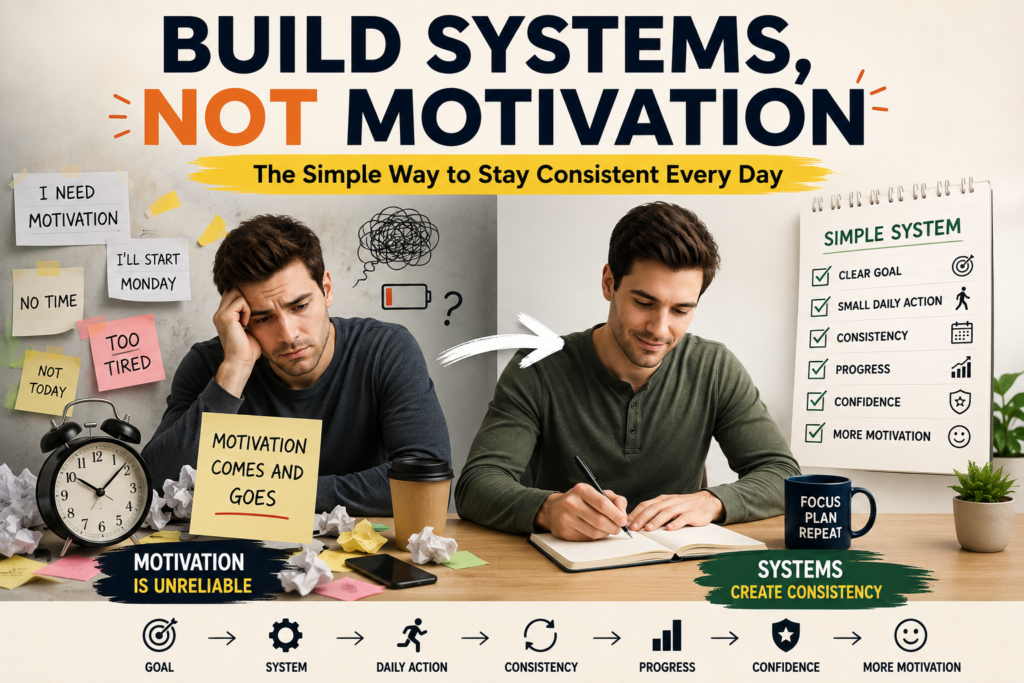
The Smart Systems Loop
Dream
↓
Goal
↓
Simple System
↓
Daily Action
↓
Consistency
↓
Progress
↓
Confidence
↓
More Motivation
Notice something important.
Motivation appears near the end—not at the beginning.
Many people wait for motivation before taking action.
In reality, motivation often grows after you’ve seen progress.
Step 1: Start With a Dream
Every meaningful goal begins with something you want to improve.
Examples include:
- Becoming healthier.
- Learning a new skill.
- Saving more money.
- Reading more books.
- Feeling less stressed.
- Building a successful business.
Dreams provide direction.
But dreams alone don’t create results.
Without a practical plan, they often remain ideas rather than achievements.
Real-Life Scenario
Chloe’s Dream
Chloe wanted to become healthier.
For years she kept saying,
“I really need to exercise more.”
That was her dream.
But nothing changed because she hadn’t transformed that dream into a clear goal.
Dreams inspire us.
Goals give those dreams direction.
Step 2: Turn the Dream Into a Goal
A goal answers the question:
“What exactly am I trying to achieve?”
Instead of saying:
“I want to read more.”
Try:
“I want to finish one book each month.”
Instead of:
“I want to exercise.”
Try:
“I want to walk for twenty minutes after dinner four days each week.”
Specific goals are much easier to support with practical systems.
Step 3: Build a Simple System
This is where most people struggle.
Instead of creating a system, they create a wish.
For example:
“I’ll exercise every day.”
That’s not a system.
A system answers practical questions such as:
- When will I do it?
- Where will I do it?
- What is the first step?
- How will I remember?
- What happens if I miss one day?
Example:
Goal
Walk regularly.
System
- Put walking shoes beside the front door.
- Walk immediately after dinner.
- Listen to one favorite podcast while walking.
- Mark each walk on a calendar.
The goal stays the same.
The system makes it easier to achieve.
Key Insight
Goals tell you where you want to go.
Systems determine whether you’ll actually get there.
Step 4: Take Small Daily Actions
A common mistake is believing every action must be impressive.
It doesn’t.
Small actions repeated consistently create extraordinary results over time.
Examples:
- Read one page.
- Write for five minutes.
- Walk around the block.
- Drink one glass of water.
- Review tomorrow’s schedule.
These actions may seem insignificant.
But because they’re easy to repeat, they become the foundation of lasting habits.
Real-Life Scenario
Marcus’s Reading System
Marcus wanted to read more books.
Every year he bought several books but rarely finished them.
Instead of setting a goal to read an hour every evening, he created one simple rule:
Read two pages before going to sleep.
Some nights he stopped after two pages.
Other nights he kept reading for twenty or thirty minutes.
The important part wasn’t reading for hours.
It was making reading easy enough to happen every day.
Step 5: Build Consistency
Consistency isn’t about perfection.
It’s about returning to your system again and again.
Everyone misses days.
Everyone experiences setbacks.
Successful people simply return to their systems more quickly.
Missing one day doesn’t destroy progress.
Giving up completely often does.
SmartHelpHub Tip
Never judge your system by one difficult day.
Judge it by whether you can return to it after life gets busy.
Resilient systems make restarting easy.
Step 6: Progress Creates Confidence
When you consistently complete small actions, something important begins to happen.
You collect evidence that you can keep promises to yourself.
That evidence becomes confidence.
Instead of thinking,
“I hope I can stay consistent.”
You begin thinking,
“I’ve done this before. I can do it again.”
Confidence grows through repeated action—not positive thinking alone.
Step 7: Motivation Returns Naturally
Here’s the surprising part.
Once you’ve experienced progress, consistency, and confidence, motivation often comes back on its own.
You no longer need to force yourself as often because your system has become part of your normal routine.
Instead of chasing motivation, you’ve created an environment where motivation naturally follows action.
That’s why systems are so powerful.
They reduce the need to rely on feelings.
The Smart Systems Loop in Everyday Life
This framework can be applied to almost any goal.
| Goal | Simple System |
|---|---|
| Exercise | Put workout clothes out the night before and exercise after breakfast. |
| Reading | Read two pages before bed every night. |
| Saving Money | Automatically transfer a small amount to savings every payday. |
| Learning | Study for fifteen minutes immediately after lunch. |
| Organization | Spend ten minutes tidying your workspace before finishing work. |
Notice that every example focuses on making the next action obvious and easy.
That’s the hallmark of a good system.
Common Mistake
Many people spend more time creating elaborate plans than following simple systems.
A complicated system that lasts three days is less effective than a simple system you repeat for three months.
Keep your first system as small as possible.
You can always improve it later.
Take Action
Choose one goal you’ve been struggling with.
Complete this simple worksheet.
| Question | Your Answer |
|---|---|
| What is my goal? | __________ |
| What is one small daily action? | __________ |
| When will I do it? | __________ |
| Where will I do it? | __________ |
| What reminder will I use? | __________ |
Don’t worry about making your system perfect.
Focus on making it easy to repeat.
That’s how lasting consistency begins.
Build One System at a Time
In Short: One of the biggest reasons people struggle to stay consistent is trying to improve every part of their life at once. The most effective systems are simple, focused, and built gradually.
After learning why systems work better than motivation, it’s tempting to redesign your entire life.
You might want to:
- Wake up earlier.
- Exercise every day.
- Read more books.
- Eat healthier.
- Organize your home.
- Learn a new skill.
While these are all worthwhile goals, trying to build several systems at the same time usually leads to frustration.
Every new system requires attention.
The more changes you make at once, the harder they become to maintain.
Instead of building five new systems, start with one.
When that system becomes part of your normal routine, build the next one.
Small improvements repeated consistently create far greater results than dramatic changes that last only a few days.
Start With Your Biggest Pain Point
Ask yourself:
“Which daily habit causes me the most frustration?”
Examples include:
- Feeling rushed every morning.
- Forgetting important tasks.
- Constantly procrastinating.
- Living in a cluttered space.
- Struggling to focus.
Choose the area that would make the biggest difference in your daily life.
That’s where your first system should begin.
Example 1: Build a Morning System
Many people want better mornings.
Instead of creating a complicated two-hour routine, build a simple system.
For example:
Trigger: Alarm rings.
↓
Drink a glass of water.
↓
Open the curtains.
↓
Stretch for five minutes.
↓
Review today’s top three priorities.
If you’d like more ideas for creating a realistic morning routine, How to Build a Simple Morning Routine That Actually Works provides practical strategies that fit into everyday life without requiring dramatic lifestyle changes.
Notice that this isn’t a list of ambitious goals.
It’s a repeatable sequence of small actions.
Example 2: Build a Work System
Rather than telling yourself,
“I’ll work harder today.”
Create a system.
Example:
- Open your task list.
- Choose one priority.
- Silence unnecessary notifications.
- Work for 25 minutes.
- Take a short break.
- Repeat.
The system removes uncertainty.
You always know what comes next.
Example 3: Build a Home Organization System
Many people wait until their home feels messy before cleaning.
Instead, create a simple maintenance system.
For example:
- Spend ten minutes tidying before dinner.
- Put items back where they belong immediately after using them.
- Review one drawer or shelf every weekend.
Learning How to Be More Organized Without Feeling Overwhelmed can help you build realistic organization systems instead of relying on occasional bursts of motivation.
Real-Life Scenario
Meet Aisha
Aisha wanted to improve her health, organize her home, read more books, and save money.
She tried changing everything at once.
Within two weeks she had stopped doing almost all of it.
Instead, she focused on one system.
Every evening before bed, she prepared a bottle of water and her walking shoes for the next morning.
After several weeks, that routine felt automatic.
Only then did she introduce a second system for meal planning.
By building one system at a time, she stayed consistent instead of overwhelmed.
Remove Friction
In Short: Good systems make positive actions easier and unwanted habits harder.
Think about how much effort a task requires.
The harder something feels to start, the less likely you’ll do it consistently.
Your goal is to remove as much friction as possible.
Make Good Habits Easier
Examples:
Instead of storing your guitar in a cupboard…
Leave it on a stand where you can see it.
Instead of searching for workout clothes each morning…
Lay them out the night before.
Instead of remembering to drink more water…
Keep a water bottle on your desk.
The easier a habit is to begin, the more likely you’ll repeat it.
Make Unhelpful Habits Harder
You can also increase friction for habits you want to reduce.
Examples:
- Keep your phone in another room while working.
- Remove distracting apps from your home screen.
- Log out of social media after each session.
- Store unhealthy snacks out of sight.
Small obstacles interrupt automatic behavior and give you a chance to make a more intentional choice.
Design Your Environment
Your environment influences your behavior more than many people realize.
Ask yourself:
- What do I see first when I wake up?
- What distractions are always within reach?
- What tools would make good habits easier?
Instead of relying on memory or willpower, arrange your surroundings to support the behavior you want.
Your environment should remind you to take action—not tempt you to delay it.
Key Insight
Willpower works for a short time.
Well-designed environments work every day.
Common Mistake
People often blame themselves when they struggle to stay consistent.
Sometimes the problem isn’t a lack of discipline.
It’s a system that creates too much friction.
Before trying harder, ask:
“How can I make this easier?”
Often, one small adjustment is enough to make a habit much more sustainable.
Build Systems That Fit Real Life
The best system isn’t the most impressive one.
It’s the one you can still follow on a busy Tuesday, after a poor night’s sleep, or during a stressful week.
Simple systems survive imperfect days.
Complicated systems usually don’t.
That’s why consistency always beats intensity.
Take Action
Choose one goal.
Now simplify it.
Complete these sentences:
My goal is:
The smallest action I can repeat every day is:
I’ll do it at this time:
My reminder will be:
Don’t build five systems today.
Build one.
Repeat it until it feels natural.
Then move on to the next.
Common Mistakes That Keep People Inconsistent
In Short: Most people don’t fail because they’re lazy or unmotivated. They struggle because they unknowingly create systems that are difficult to maintain. Avoiding these common mistakes will make consistency much easier.
Even the best intentions can fail if your system isn’t realistic.
Let’s look at the mistakes that stop many people from making lasting progress.
Mistake 1: Building Too Many Systems at Once
When people feel inspired, they often try to improve every part of their life.
For example:
- Wake up at 5:00 a.m.
- Exercise every day.
- Read for an hour.
- Eat perfectly.
- Journal every morning.
- Meditate.
- Learn a new language.
It sounds exciting.
But maintaining all of these changes at the same time requires a huge amount of mental energy.
Instead, choose one system.
Allow it to become part of your routine before adding another.
Real-Life Scenario
Ryan’s Fresh Start
Ryan decided that the beginning of the month would be his “new life.”
He created a detailed schedule covering exercise, meal planning, studying, budgeting, and home organization.
By the second week, he felt exhausted trying to keep up.
Instead of abandoning his goals, Ryan restarted with one simple system:
Preparing tomorrow’s to-do list every evening.
Once that became automatic, he gradually added more systems.
The difference wasn’t motivation.
It was starting small.
Mistake 2: Waiting for Motivation
Many people delay action because they don’t feel ready.
They tell themselves:
- “I’ll start next Monday.”
- “I’ll begin after my vacation.”
- “I’ll wait until work calms down.”
Unfortunately, waiting often becomes another form of procrastination.
A good system helps you begin even when conditions aren’t perfect.
Key Insight
Action creates momentum.
Momentum creates confidence.
Confidence often creates motivation.
Waiting for motivation usually delays all three.
Mistake 3: Making Systems Too Complicated
A system should reduce mental effort—not increase it.
If your system contains dozens of steps, it’s unlikely to survive a busy day.
For example:
❌ Read for an hour every evening.
✅ Read two pages before bed.
❌ Exercise for ninety minutes.
✅ Walk for ten minutes after lunch.
Simple systems are easier to repeat, and repetition is what creates long-term results.
Mistake 4: Expecting Perfection
Many people believe that missing one day means they’ve failed.
It doesn’t.
Life will interrupt your plans.
You will become sick.
You’ll travel.
Unexpected responsibilities will appear.
Consistency doesn’t mean never missing a day.
It means returning to your system as soon as you can.
Mistake 5: Comparing Your Systems to Someone Else’s
It’s easy to look at productivity videos or social media and think you should be doing more.
But the best system isn’t the most impressive.
It’s the one that fits your life.
A parent, a student, and a business owner all have different schedules and responsibilities.
Your system should support your reality—not someone else’s.
SmartHelpHub Tip
If a system regularly feels stressful, ask yourself:
“How can I make this easier?”
Small adjustments often create better long-term results than trying harder.
Build Your First System Today
Instead of leaving this guide with ideas alone, create your first system now.
Complete the worksheet below.
SmartHelpHub System Builder Worksheet
| Question | Your Answer |
|---|---|
| What goal do I want to achieve? | __________ |
| What is the smallest daily action? | __________ |
| When will I do it? | __________ |
| Where will I do it? | __________ |
| What will remind me? | __________ |
| How will I know I completed it? | __________ |
| What will I do if I miss one day? | __________ |
Keep your answers simple.
A system should remove uncertainty—not create more of it.
The 30-Day Systems Challenge
Lasting change doesn’t happen overnight.
That’s why this challenge focuses on one small system rather than dramatic transformation.
Week 1 – Build
Choose one goal.
Create one simple system.
Don’t add anything else.
Week 2 – Repeat
Focus on consistency.
Don’t worry about doing more.
Just repeat your system.
Week 3 – Improve
Ask yourself:
- What’s working well?
- What’s difficult?
- How can I reduce friction?
Adjust your system if needed.
Week 4 – Review
Look back on the month.
Celebrate progress.
Notice what became easier.
Decide whether to improve the existing system or build a second one.
Remember:
The goal isn’t perfection.
The goal is creating a lifestyle you can realistically maintain.
Frequently Asked Questions
Can systems really replace motivation?
Not completely.
Motivation is still helpful.
However, well-designed systems reduce how often you need to rely on motivation to take action.
What’s the difference between a goal and a system?
A goal is the outcome you want.
A system is the repeatable process that helps you reach that outcome.
How many systems should I build at once?
Start with one.
Once it feels natural, add another.
Trying to build several systems simultaneously often leads to overwhelm.
What if I miss a day?
Missing one day is normal.
Return to your system the next day instead of waiting for the “perfect” time to restart.
How long does it take for a system to feel natural?
It varies from person to person.
Instead of focusing on a specific number of days, focus on repeating the behavior consistently.
Can I change my system later?
Absolutely.
Systems should evolve as your goals and circumstances change.
The best system is one that continues supporting your life over time.
Do systems work for small goals too?
Yes.
In fact, simple systems are often most effective for small daily habits because they remove unnecessary decision-making.
What if my schedule changes every day?
Build your system around consistent events rather than exact times.
For example:
After breakfast
Before leaving work
Before bed
These cues are often easier to maintain than fixed clock times.
Key Takeaways
- Motivation naturally rises and falls.
- Systems reduce the need to rely on willpower.
- Start with one simple, repeatable action.
- Make good habits easier and unwanted habits harder.
- Progress comes from consistency—not perfection.
- Improve your system instead of blaming yourself.
- Small actions repeated daily create meaningful long-term results.
Final Thoughts
Many people spend years searching for more motivation.
They read books.
Watch videos.
Wait for the perfect moment.
But lasting change rarely begins with a surge of inspiration.
It begins with a simple system that makes taking the next step easier.
Remember:
You don’t have to transform your entire life this week.
You only have to create one system that supports one meaningful goal.
Repeat it.
Improve it.
Trust the process.
Over time, those small systems become the foundation for lasting confidence, steady progress, and a life that feels more intentional.
Take Action Today
Before closing this page, write down one sentence:
“The first system I’m building is __________________.”
Then decide:
- What is the smallest action?
- When will you do it?
- What will remind you?
Don’t wait for motivation tomorrow.
Build a system today that makes tomorrow’s action easier.