Quick Answer
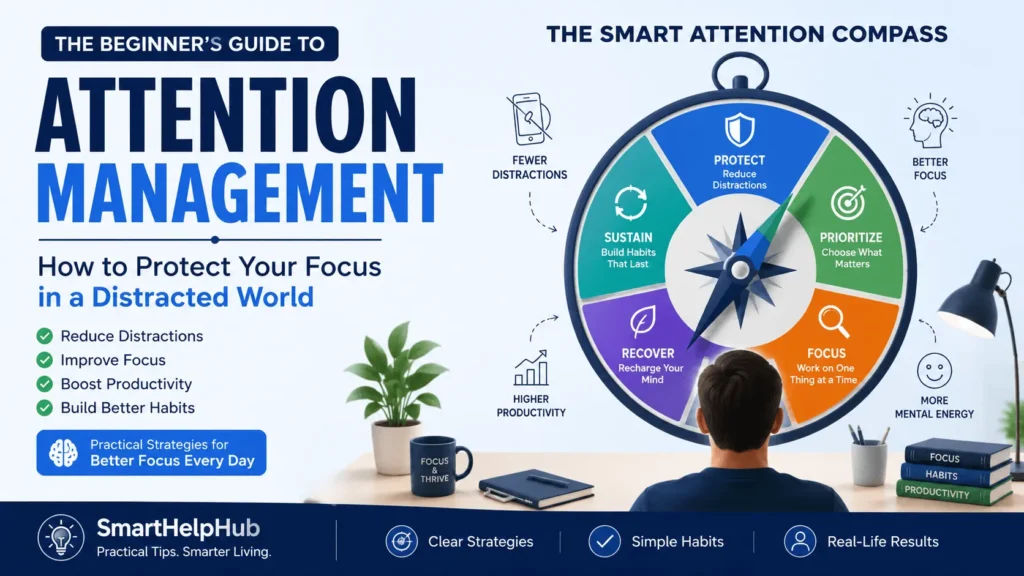
Attention management is the ability to intentionally choose where your mental focus goes instead of constantly reacting to distractions. Unlike time management, which focuses on how you schedule your day, attention management helps you protect your limited mental energy so you can concentrate on what matters most. By understanding how attention works and applying the Smart Attention Compass, you can reduce distractions, improve concentration, and build habits that make staying focused easier in a world filled with interruptions.
At a Glance
Best For
- Students
- Professionals
- Remote workers
- Business owners
- Parents
- Anyone who struggles to stay focused
What You’ll Learn
✔ What attention management really means
✔ Why staying focused feels harder than ever
✔ The biggest habits that steal your attention
✔ A practical five-part system to improve focus every day
✔ How to protect your attention without completely disconnecting from technology
Take Action Today
Before finishing this guide, spend five minutes identifying the biggest distraction in your daily routine.
You don’t need to eliminate every distraction.
You simply need to become aware of the one that affects you the most.
Table of Contents
- What Is Attention Management?
- Why It’s Harder Than Ever to Focus
- The Smart Attention Compass
- How to Protect Your Attention Every Day
- Common Attention Management Mistakes
- The 15-Minute Focus Reset
- Signs Your Attention Is Improving
- Frequently Asked Questions
- Key Takeaways
- The 7-Day Attention Reset Challenge
Introduction
Have you ever sat down to work with every intention of staying focused, only to realize an hour later that you’ve barely made any progress?
Maybe you checked your email first.
Then you replied to a message.
A notification appeared on your phone.
You remembered something you needed to search for.
Before long, your attention had moved through half a dozen different tasks without finishing any of them.
If this sounds familiar, you’re far from alone.
Many people believe they have a time management problem when, in reality, they have an attention management problem.
You may have enough hours in the day.
You may even have a well-organized schedule.
Yet meaningful work still feels difficult because your attention is constantly being redirected.
Modern technology isn’t entirely to blame.
Open browser tabs, endless streams of information, social media, workplace interruptions, and everyday responsibilities all compete for the same limited mental resource—your attention.
The more often your attention shifts, the harder it becomes to think deeply, solve problems, and complete important work.
The good news is that attention is a skill.
Like any skill, it can be strengthened through simple habits and consistent practice.
You don’t need perfect concentration.
You don’t need to eliminate every distraction.
You simply need a better system.
In this guide, you’ll learn the Smart Attention Compass, a practical framework designed to help you protect your attention, prioritize what matters, improve your focus, recover your mental energy, and build habits that support long-term concentration.
By the end of this guide, you’ll understand why attention matters more than ever—and you’ll have a realistic plan for improving it one step at a time.
Who This Guide Is For
This guide is designed for anyone who feels that staying focused has become more difficult than it used to be.
It will be especially helpful if you:
- Frequently switch between tasks without finishing them.
- Feel distracted by your phone or computer.
- Find it difficult to concentrate for long periods.
- Often forget what you were about to do.
- Want to improve your productivity without working longer hours.
- Feel mentally drained by the end of the day, even when you haven’t completed your most important work.
- Want practical strategies instead of complicated productivity systems.
Whether you’re studying for exams, working from home, managing a busy office schedule, or balancing family responsibilities, the ideas in this guide are designed to fit into everyday life.
You don’t need special tools.
You don’t need expensive software.
You simply need a better understanding of how attention works—and how to protect it.
Who This Guide Is NOT For
This guide may not be the best fit if you’re looking for:
- Medical advice or treatment for a diagnosed attention-related condition.
- Advanced neuroscience or academic research papers.
- A quick productivity hack that promises instant results without changing your habits.
Instead, this guide focuses on practical, evidence-informed strategies that help most people improve their daily attention and reduce unnecessary distractions.
SmartHelpHub Tip
Your attention is like a flashlight, not a floodlight. Wherever you point it becomes clearer—but everything else fades into the background. Choose where you aim it carefully.
Key Insight
Many people try to manage their time more effectively.
Far fewer learn to manage their attention.
Yet attention is the resource that determines how well you use your time in the first place.
Protecting your attention often leads to better productivity without adding more hours to your day.
Real-Life Scenario
Daniel’s Busy Morning
Daniel starts work at 9:00 a.m. with three important tasks planned for the day.
Before beginning, he checks his email “for just a minute.”
One message reminds him about a meeting.
While opening his calendar, a chat notification appears.
He replies.
Then he notices a news alert on his phone.
A few minutes later, he remembers an online article he wanted to read and opens another browser tab.
By 9:45 a.m., Daniel has been busy the entire time—but he hasn’t started his most important task.
Nothing unusual happened.
His attention was simply redirected over and over again.
Throughout this guide, you’ll learn how the Smart Attention Compass helps prevent these small interruptions from controlling your day.
Take Action
Before moving to the next section, take one minute to answer this question:
What distracts me most during a typical day?
Write down the first three things that come to mind.
Don’t try to solve them yet.
Simply becoming aware of your biggest attention thieves is the first step toward managing them more effectively.
What Is Attention Management?
In Short: Attention management is the ability to intentionally direct and protect your focus instead of allowing distractions to decide where your mental energy goes. Unlike time management, it focuses on the quality of your attention—not just how you schedule your day.
Most people believe they don’t have enough time.
In reality, many of us have enough time—we simply lose control of our attention.
Think about a typical morning.
You sit down to start an important task.
Before you begin, you quickly check your email.
Then you notice a message from a coworker.
A notification appears on your phone.
You remember something you wanted to search online.
Suddenly, twenty minutes have passed, and you haven’t started what you originally planned to do.
Your time didn’t disappear.
Your attention did.
That’s why attention management has become one of the most valuable skills in modern life.
Instead of asking:
“How can I fit more into my day?”
Attention management asks:
“How can I give my full attention to what matters most?”
That small shift changes everything.
Attention Is a Limited Resource
Unlike your calendar, your attention isn’t unlimited.
Every conversation, decision, notification, advertisement, email, and interruption competes for the same mental resource.
Imagine your attention as a rechargeable battery.
Every time you switch tasks, respond to an unnecessary notification, or interrupt your own work, a small amount of that battery is used.
The more often this happens, the more difficult it becomes to think clearly and stay focused.
That’s why many people feel mentally tired even on days when they haven’t done physically demanding work.
Their attention has been constantly divided.
Attention Management vs. Time Management
These two ideas are closely related, but they’re not the same.
| Time Management | Attention Management |
|---|---|
| Focuses on your schedule | Focuses on your mental focus |
| Asks how to use your hours | Asks how to use your attention |
| Organizes tasks | Protects concentration |
| Helps you plan your day | Helps you stay present while working |
| Measures time | Protects mental energy |
You can have a perfectly planned schedule and still struggle to complete meaningful work if your attention is constantly interrupted.
That’s why learning attention management often has a greater impact than simply finding another productivity technique.
Why Attention Matters More Than Ever
Today’s world is designed to compete for your attention.
Consider how many things try to interrupt you each day:
- Emails
- Text messages
- Social media
- News alerts
- Advertisements
- Meetings
- Phone calls
- Browser tabs
- Streaming platforms
Each interruption asks for just a few seconds.
But together, they can consume hours of your day.
Protecting your attention isn’t about avoiding technology.
It’s about deciding what deserves your attention—and what doesn’t.
Real-Life Scenario
Maya’s Study Session
Maya planned to spend an hour studying for an important exam.
Within the first fifteen minutes she:
- Replied to two text messages.
- Checked the weather.
- Looked at a social media notification.
- Opened three unrelated browser tabs.
- Answered an email.
By the end of the hour, she’d technically been “studying” the whole time.
But because her attention kept shifting, she made far less progress than she expected.
The problem wasn’t motivation.
It was that her attention never stayed in one place long enough to do meaningful work.
SmartHelpHub Tip
Instead of asking:
“How much time do I have?”
Start asking:
“What deserves my full attention right now?”
That single question can help you make better decisions throughout the day.
Why It’s Harder Than Ever to Focus
In Short: Modern life constantly competes for your attention. Notifications, multitasking, endless information, and frequent interruptions make it difficult to stay focused for long periods—even when you’re motivated.
If staying focused feels harder than it used to, you’re not imagining it.
Technology has made information easier to access than ever before.
At the same time, it has also made distractions easier to access.
Every app, website, and platform competes for one thing:
Your attention.
Notifications Constantly Interrupt Your Thinking
Every notification creates a decision.
Should you check it?
Ignore it?
Respond immediately?
Save it for later?
Even if you decide not to open the notification, your attention has already shifted.
That’s why learning to manage notification overload is one of the first steps toward protecting your focus throughout the day.
When fewer unnecessary alerts interrupt you, it’s much easier to stay engaged with important work.
Information Never Stops
Unlike previous generations, we rarely reach the end of the information available to us.
There is always:
- Another article
- Another video
- Another podcast
- Another message
- Another news story
Because information is unlimited, your attention becomes the resource that must be managed.
You don’t need to consume everything.
You need to decide what deserves your attention.
Multitasking Feels Productive—But Often Isn’t
Many people believe multitasking helps them accomplish more.
In reality, constantly switching between tasks forces your brain to repeatedly refocus.
Imagine writing an important report while also:
- Replying to messages
- Watching videos
- Checking email
- Browsing social media
Although it feels like you’re doing several things at once, your attention is jumping rapidly between activities.
Each switch creates a small interruption.
Over time, those interruptions reduce the quality of your work.
Constant Context Switching Drains Mental Energy
Context switching happens whenever you stop thinking about one task and begin another.
For example:
You’re writing a report.
↓
You answer a phone call.
↓
You reply to an email.
↓
You return to your report.
Even if each interruption lasts only a minute or two, your brain needs time to fully re-engage with the original task.
The more often this happens, the harder it becomes to maintain deep concentration.
We Often Interrupt Ourselves
Not every distraction comes from outside.
Sometimes we create them ourselves.
Examples include:
- Checking your phone without thinking.
- Opening a new browser tab out of habit.
- Refreshing your inbox repeatedly.
- Switching tasks because something feels difficult.
These small habits often become automatic.
The good news is that they can also be changed.
Did You Know?
Research in psychology suggests that your brain performs best when it can focus on one meaningful task at a time without frequent interruptions. Even brief distractions can reduce concentration and make it take longer to fully return to the original task.
Key Insight
Your attention isn’t being stolen all at once.
It’s usually lost through dozens of tiny interruptions that seem harmless on their own.
Protecting your attention begins by recognizing those interruptions before they become habits.
Take Action
Take two minutes to observe your current environment.
Ask yourself:
- What interrupts me most often?
- Which distractions are outside my control?
- Which distractions am I creating myself?
Write down your answers.
You’ll use them in the next section as we build your personal Smart Attention Compass.
The Smart Attention Compass
In Short: Attention isn’t something you either have or don’t have—it’s something you can manage. The Smart Attention Compass is a simple five-pillar framework that helps you protect your focus, prioritize what matters, work with greater concentration, recover your mental energy, and build habits that last.
Many people believe improving focus requires more discipline or willpower.
In reality, most attention problems come from having too many competing demands rather than a lack of motivation.
That’s why trying harder isn’t always the answer.
Instead of relying on willpower alone, you need a system that helps you make better decisions before distractions take over.
The Smart Attention Compass provides that system.
Rather than fighting every distraction as it appears, you’ll learn how to guide your attention in a more intentional way through five simple pillars.
Pillar 1: Protect Your Attention
Before you can improve your focus, you need to reduce unnecessary interruptions.
Think of your attention as something valuable.
If someone interrupted an important conversation every few minutes, it would be difficult to communicate effectively.
Your work deserves the same protection.
Ask yourself:
- Which apps interrupt me most often?
- Which websites pull my attention away?
- Which habits make me lose focus?
Protection isn’t about eliminating technology.
It’s about deciding when technology gets access to your attention.
Real-Life Scenario
Alex’s Workday
Alex begins every morning intending to focus on an important project.
However, before starting, he checks email, opens team chat, glances at the news, and responds to two messages.
By the time he starts working, nearly thirty minutes have disappeared.
The interruptions weren’t emergencies.
They were simply allowed to happen before his most important work began.
Protecting attention means creating space for meaningful work before outside demands take over.
SmartHelpHub Tip
Ask yourself this question whenever something interrupts you:
“Does this deserve my attention right now?”
You’ll be surprised how often the answer is “not yet.”
Pillar 2: Prioritize What Matters
Once you’ve reduced unnecessary interruptions, the next step is deciding where your attention should go.
Many people begin their day by reacting.
They answer messages.
Check email.
Browse notifications.
Then, if there’s time left, they work on important goals.
Reverse that order.
Choose your most valuable task before your day becomes busy.
One simple way to do this is by create a daily to-do list that you’ll actually follow so your priorities are already clear before distractions begin.
When you know what deserves your attention, it’s much easier to ignore what doesn’t.
Attention Is a Choice
Your attention naturally follows whatever seems most urgent.
Unfortunately, urgent isn’t always important.
Before starting work each day, ask yourself:
- What is today’s most meaningful task?
- If I only complete one thing today, what should it be?
- What can wait until later?
These questions help direct your attention instead of allowing your environment to decide for you.
Pillar 3: Focus Deeply
Protecting attention creates opportunities.
Focused work creates results.
Deep focus doesn’t mean working for hours without moving.
It means giving one important task your complete attention for a meaningful period of time.
During these sessions:
- Close unrelated browser tabs.
- Silence unnecessary devices.
- Keep only the resources you need.
- Resist switching tasks.
Each time you avoid an interruption, you’re strengthening your ability to concentrate.
Like any skill, focus improves with practice.
Quick Checklist
Before starting focused work:
☐ Phone out of reach
☐ Unnecessary tabs closed
☐ Notifications silenced
☐ Clear objective written down
☐ Water nearby
☐ Workspace prepared
Small preparation often leads to much better concentration.
Pillar 4: Recover Your Attention
Many people believe productivity means staying focused all day.
That’s unrealistic.
Attention naturally rises and falls.
Recovery is what allows you to focus well again.
Healthy recovery might include:
- Standing up and stretching
- Taking a short walk
- Looking away from your screen
- Drinking water
- Spending a few quiet minutes away from digital devices
Building these recovery habits works especially well alongside small habits that calm an overstimulated mind, which can help reduce mental overload between demanding tasks.
Recovery isn’t wasted time.
It’s an investment in your next period of focused work.
Did You Know?
Your brain benefits from short breaks between periods of concentrated work. Stepping away for a few minutes can help reduce mental fatigue and make it easier to return with fresh attention.
Pillar 5: Sustain Your Attention
Anyone can focus well for one day.
The real challenge is creating habits that protect your attention every week.
Long-term success comes from consistency rather than intensity.
Simple habits include:
- Beginning your day intentionally.
- Limiting unnecessary interruptions.
- Scheduling regular breaks.
- Ending your workday with a quick review.
- Preparing tomorrow’s priorities before finishing today.
Many people find these habits easier to maintain when they begin with build a simple morning routine that actually works, creating a predictable start to each day before distractions appear.
Small daily routines often have a greater long-term impact than occasional bursts of motivation.
The Smart Attention Compass at a Glance
| Pillar | Purpose | Daily Action |
|---|---|---|
| 🧭 Protect | Reduce unnecessary interruptions | Silence non-essential distractions before important work |
| 🎯 Prioritize | Choose what deserves attention | Identify your most important task first |
| 🔍 Focus | Give one task your full attention | Work in distraction-free focus sessions |
| 🌿 Recover | Restore mental energy | Take intentional short breaks |
| 🔄 Sustain | Build lasting habits | Follow simple daily routines that protect attention |
Key Insight
Attention isn’t protected by working harder.
It’s protected by making better decisions before distractions appear.
When you build systems that support your attention, staying focused becomes much easier than relying on willpower alone.
Take Action
Choose one pillar of the Smart Attention Compass to focus on this week.
Don’t try to improve everything at once.
Ask yourself:
- Do I need better protection from distractions?
- Do I need clearer priorities?
- Do I need longer periods of focus?
- Do I need more recovery?
- Do I need better daily habits?
Improving just one pillar can create meaningful improvements in how you work and feel.
How to Protect Your Attention Every Day
In Short: Protecting your attention isn’t about avoiding every distraction—it’s about creating simple habits that help you stay focused on what matters most. Small, consistent changes often have a bigger impact than dramatic productivity overhauls.
Many people think improving focus requires a complete lifestyle change.
Fortunately, it doesn’t.
The most effective attention management habits are usually simple enough to fit into your existing routine.
Instead of trying to eliminate every distraction, focus on reducing the ones that matter most.
Follow these six practical steps.
Step 1: Identify Your Attention Thieves
Before you can protect your attention, you need to know what’s stealing it.
For one day, observe your habits without trying to change them.
Ask yourself:
- What interrupts me most often?
- Which distractions are external?
- Which distractions do I create myself?
- When do I lose focus most easily?
Some common attention thieves include:
- Phone notifications
- Social media
- Background television
- Open browser tabs
- Frequent meetings
- Multitasking
- Internal worries
Awareness is the first step toward improvement.
📖 Real-Life Scenario
Priya’s Afternoon Slump
Every afternoon around 2:30 p.m., Priya notices herself checking social media several times.
At first, she assumes she’s lazy.
After tracking her habits for a week, she realizes something different.
She’s actually mentally tired after several hours of focused work.
Instead of forcing herself to concentrate, she begins taking a short walk before returning to work.
The urge to scroll decreases because she addressed the real problem—mental fatigue—not the symptom.
Step 2: Reduce Interruptions Before They Happen
Waiting until you’re distracted is often too late.
Protect your attention before beginning important work.
Simple actions include:
- Silence non-essential notifications.
- Put your phone out of reach.
- Close unrelated browser tabs.
- Tell coworkers when you’re unavailable.
- Keep only the materials you need open.
The fewer interruptions available, the fewer decisions your brain has to make.
💡 SmartHelpHub Tip
Create a short “Focus Setup” routine before every important task.
For example:
- Close messaging apps.
- Fill your water bottle.
- Open only the documents you need.
- Set your phone aside.
Repeating the same routine helps signal to your brain that it’s time to concentrate.
Step 3: Work With Your Energy, Not Against It
Attention naturally changes throughout the day.
Some people think most clearly in the morning.
Others do their best work later in the day.
Instead of forcing difficult tasks into low-energy periods, learn when you’re naturally most alert.
Try asking yourself:
- When do I think most clearly?
- When do I usually feel tired?
- Which tasks require the most concentration?
Schedule your most important work during your highest-energy periods whenever possible.
⭐ Key Insight
Time matters.
But energy often matters more.
Working on important tasks when your mind is fresh usually produces better results than simply working longer.
Step 4: Focus on One Task at a Time
Multitasking often feels productive because you’re constantly busy.
But being busy isn’t the same as making progress.
When working on something important:
Choose one task.
Complete one meaningful section.
Then move to the next.
Imagine reading a book while checking your phone every few minutes.
You might finish the chapter eventually, but you’ll probably remember much less.
Focused attention creates higher-quality work and reduces unnecessary mental effort.
📋 Quick Checklist Before Starting Work
Before beginning an important task, ask yourself:
☐ Do I know exactly what I’m trying to accomplish?
☐ Is my phone out of reach?
☐ Have I closed unnecessary tabs?
☐ Do I have everything I need?
☐ Have I removed obvious distractions?
If you answered “yes” to all five questions, you’ve already improved your chances of staying focused.
Step 5: Build Intentional Breaks
Many people wait until they’re mentally exhausted before taking a break.
Instead, take short breaks before your attention completely fades.
Good break ideas include:
- Walk for five minutes.
- Stretch your body.
- Drink water.
- Look outside.
- Step away from your screen.
Avoid replacing one digital activity with another.
For example, switching from work to endless social media scrolling rarely gives your mind meaningful recovery.
Did You Know?
Even a brief change of environment—such as standing up, walking, or looking outside—can help reduce mental fatigue and prepare your brain for another period of focused work.
Step 6: Reflect at the End of Your Day
Attention management improves when you learn from your own patterns.
Before finishing work, ask yourself:
- When did I focus best today?
- What distracted me the most?
- What helped me stay on track?
- What can I improve tomorrow?
This simple habit takes less than two minutes but helps you notice patterns that would otherwise go unnoticed.
Over time, you’ll discover the environments, routines, and habits that support your attention best.
Daily Attention Protection Routine
Here’s a simple routine you can follow every day.
| Time | Action | Purpose |
|---|---|---|
| Morning | Identify your most important task | Create clear priorities |
| Before work | Remove distractions | Protect attention |
| During work | Focus on one task | Improve concentration |
| Midday | Take an intentional break | Recover mental energy |
| Afternoon | Review priorities | Stay on track |
| End of day | Reflect for two minutes | Improve tomorrow |
This routine takes very little extra time but creates a structure that supports better attention throughout the day.
Common Mistake
Many people expect perfect focus.
That’s unrealistic.
Everyone gets distracted.
The goal isn’t to eliminate distractions completely.
The goal is to notice them sooner and return your attention more quickly.
Progress—not perfection—is what leads to lasting improvement.
Take Action
Choose one attention habit from this section and practice it every day for the next week.
Good options include:
- Creating a Focus Setup routine.
- Working on one task at a time.
- Taking intentional breaks.
- Ending each day with a two-minute reflection.
One consistent habit will improve your attention more than trying ten new techniques at once.
Real-Life Scenario
James’ Small Change
James believed he needed a better productivity app.
Instead, he made one simple change.
Before starting work each morning, he placed his phone in another room for one hour.
Nothing else changed.
Within a few days, he noticed he completed his most important work earlier and felt less mentally scattered.
His improvement came from protecting his attention—not from working longer.
Common Attention Management Mistakes
In Short: Improving your attention isn’t only about adopting better habits—it’s also about recognizing the behaviors that quietly undermine your focus every day. Avoiding these common mistakes can help you stay productive without relying on willpower alone.
Many people assume they have poor concentration when, in reality, their daily habits constantly interrupt their attention.
The encouraging news is that these habits can be changed.
Let’s look at the most common mistakes and how to avoid them.
Mistake 1: Trying to Multitask
Multitasking has become a badge of honor for many people.
You answer emails during meetings.
Reply to messages while working.
Watch videos while studying.
Switch between multiple browser tabs every few minutes.
Although it feels productive, your brain is actually shifting attention from one task to another.
Each switch requires your brain to stop, adjust, and refocus.
Instead of completing one task efficiently, you’re repeatedly restarting your concentration.
A Better Approach
Choose one meaningful task.
Finish a clear milestone.
Then move to the next activity.
Single-tasking often leads to higher-quality work and less mental fatigue.
Real-Life Scenario
Emily’s Busy Afternoon
Emily believed she was excellent at multitasking.
She answered emails while preparing a presentation and frequently checked her messaging app.
By the end of the afternoon, she had spent hours working but still needed another hour to fix mistakes she made while switching between tasks.
When she began focusing on one task at a time, she finished earlier and with fewer errors.
Mistake 2: Starting Your Day Reactively
Many people begin their mornings like this:
- Check notifications
- Open email
- Read news
- Browse social media
- Respond to messages
Only afterward do they think about their most important work.
By then, their attention has already been scattered.
A Better Approach
Start your day with intention.
Identify your most important task before opening apps that compete for your attention.
This small habit gives your priorities a chance to guide your day instead of your notifications.
SmartHelpHub Tip
Your first ten minutes often shape the next several hours.
Protect them carefully.
Mistake 3: Ignoring Your Digital Environment
Attention doesn’t exist in isolation.
Your surroundings influence your ability to concentrate.
A desktop filled with files, dozens of browser tabs, and constant digital clutter all compete for your attention—even if you’re trying to ignore them.
Creating a cleaner workspace becomes much easier after you organize your digital life, because your environment begins supporting your focus instead of competing with it.
A calm workspace encourages a calmer mind.
Mistake 4: Working Without Clear Priorities
When every task feels equally important, it’s difficult to decide where your attention should go.
As a result, people often choose the easiest task instead of the most meaningful one.
You may spend hours staying busy while making little real progress.
A Better Approach
Before beginning work, identify one priority that will make the biggest difference if completed today.
Allow your attention to follow your priorities—not simply whatever appears first.
Key Insight
Attention follows clarity.
When your priorities are clear, your focus becomes easier to maintain.
Mistake 5: Never Giving Your Brain Time to Recover
Many people believe taking breaks reduces productivity.
In reality, your attention naturally becomes less effective after long periods of concentration.
Without recovery, your focus gradually weakens.
You become slower.
More distracted.
More likely to make mistakes.
Recovery isn’t the opposite of productivity.
It’s part of it.
Did You Know?
Professional athletes don’t train at maximum intensity every minute of every workout.
They alternate effort with recovery.
Your attention benefits from the same balance.
Mistake 6: Expecting Perfect Focus
One of the biggest misconceptions about attention management is believing successful people never get distracted.
Everyone gets distracted.
The difference is how quickly they notice it and return to their work.
Instead of criticizing yourself every time your attention wanders, simply bring it back.
Think of attention as a muscle.
Every time you redirect it, you’re strengthening it.
Common Mistake
Don’t measure your progress by asking:
“Did I stay focused all day?”
Instead ask:
“How quickly did I return to my task after getting distracted?”
That’s a far better measure of improving attention.
Attention Management Isn’t About Perfection
Some days you’ll focus easily.
Other days will feel difficult.
That’s completely normal.
Stress.
Sleep.
Health.
Workload.
Unexpected events.
All influence your attention.
The goal isn’t perfect concentration.
The goal is building systems that help you return to what matters more quickly and more consistently.
The Cost of Small Distractions
Imagine being interrupted for just two minutes every half hour during an eight-hour workday.
Those interruptions may seem insignificant on their own.
Yet together they create:
- Lost momentum
- More mistakes
- Increased frustration
- Slower decision-making
- Greater mental fatigue
Protecting your attention isn’t about saving two minutes.
It’s about protecting the quality of the hours that follow.
Quick Self-Assessment
How many of these habits describe your typical day?
☐ I frequently switch between tasks.
☐ I check my phone without thinking.
☐ I open email before deciding on my priorities.
☐ My workspace feels visually distracting.
☐ I rarely take intentional breaks.
☐ I often end the day wondering where my time went.
The more boxes you checked, the greater the opportunity to improve your attention with small, consistent changes.
Take Action
Choose one attention management mistake from this section.
For the next three days, focus only on improving that single habit.
Don’t try to change everything.
Small, intentional improvements are easier to maintain—and they often lead to the biggest long-term results.
The 15-Minute Focus Reset
In Short: You don’t need an entire day to regain your focus. A simple 15-minute reset can reduce mental clutter, restore your attention, and prepare you for your next period of meaningful work.
Some days your attention feels scattered before you’ve even started working.
Maybe you’ve been jumping between meetings.
Maybe you’ve answered dozens of emails.
Or perhaps you’ve simply been thinking about too many things at once.
Instead of pushing yourself harder, pause for fifteen minutes.
A short reset can often help you return with greater clarity than forcing yourself to keep working.
The 15-Minute Focus Reset is designed to calm your mind, reduce distractions, and prepare you for your next important task.
Minute 1–3: Reset Your Environment
Your surroundings influence your attention more than you may realize.
Before returning to work:
- Close unnecessary browser tabs.
- Put your phone out of reach.
- Clear your desk.
- Open only the files you need.
- Silence unnecessary notifications.
The goal isn’t perfection.
It’s removing visual and mental distractions before they compete for your attention.
Real-Life Scenario
Sofia’s Reset Routine
Sofia noticed she often felt overwhelmed after several back-to-back meetings.
Instead of immediately starting another task, she spent three minutes clearing her desk, closing extra tabs, and preparing the document she needed next.
Those few minutes made it much easier to focus because she wasn’t surrounded by unnecessary distractions.
Minute 4–6: Clear Your Mind
When your thoughts are racing, concentration becomes much harder.
Take a notebook—or a notes app—and quickly write down anything that’s occupying your mind.
Examples:
- Ideas
- Reminders
- Questions
- Personal errands
- Tasks for tomorrow
Don’t organize them yet.
Simply get them out of your head.
This creates more mental space for the work you’re about to begin.
SmartHelpHub Tip
Your brain is great at generating ideas.
It isn’t designed to store every reminder all day.
Writing things down frees your attention for the task in front of you.
Minute 7–9: Choose One Priority
Resist the temptation to work on everything.
Ask yourself:
“If I only complete one meaningful task in the next hour, what should it be?”
Write that task at the top of your page.
Ignore everything else until you’ve made meaningful progress.
Clarity reduces hesitation.
And less hesitation means more attention for the work that matters.
Minute 10–12: Prepare to Focus
Before you begin:
✔ Water nearby
✔ Comfortable seating
✔ Required documents open
✔ Phone away
✔ Clear objective
These small actions remove unnecessary friction before your work even begins.
Key Insight
Focus isn’t created the moment you start working.
It’s created by everything you do before you begin.
Preparation is part of concentration.
Minute 13–15: Begin Immediately
Don’t spend another five minutes planning.
Don’t reorganize your folders.
Don’t check your inbox “one last time.”
Simply begin.
Even five minutes of focused work creates momentum.
Momentum makes it easier to continue.
Waiting for perfect motivation usually delays meaningful progress.
Did You Know?
Behavior research consistently shows that getting started is often the hardest part of any task. Once you’ve begun, continuing usually feels much easier because your brain has already shifted into work mode.
The 15-Minute Focus Reset Checklist
Use this checklist whenever your attention feels scattered.
Environment
☐ Close unnecessary tabs
☐ Silence distractions
☐ Clear your workspace
Mind
☐ Write down distracting thoughts
☐ Empty your mental “to-do” list
Priorities
☐ Choose one meaningful task
☐ Ignore everything else for now
Preparation
☐ Gather what you need
☐ Remove obvious interruptions
Action
☐ Start immediately
☐ Don’t wait for motivation
Signs Your Attention Is Improving
In Short: Better attention isn’t measured by never getting distracted. It’s measured by how consistently you can return your focus to what matters.
Improvement often happens gradually.
You may not notice dramatic changes overnight.
Instead, pay attention to these small signs.
You Finish More of What You Start
Instead of constantly switching between unfinished tasks, you begin completing meaningful work before moving on.
Progress feels steadier.
You Notice Distractions Earlier
Rather than automatically opening another app or browser tab, you catch yourself sooner.
Awareness is one of the earliest signs that your attention is improving.
Your Mind Feels Less Overloaded
When your attention is better protected, you’re no longer trying to think about everything at once.
Many readers also notice they’re making fewer unnecessary choices throughout the day, especially after learning how to reduce decision fatigue in daily life.
Reducing mental clutter creates more space for focused thinking.
You Recover More Quickly After Interruptions
Distractions still happen.
The difference is that you return to your work faster instead of spending twenty minutes trying to regain your concentration.
That recovery is a sign of progress.
You Feel More Present
Whether you’re working, reading, studying, or talking with someone, you’re able to stay engaged for longer periods.
Conversations become more meaningful.
Work becomes more satisfying.
Even hobbies often become more enjoyable because your attention isn’t constantly being pulled elsewhere.
You End the Day Feeling Accomplished
Being busy and being productive aren’t the same thing.
As your attention improves, you’ll likely spend more time on meaningful work and less time reacting to constant interruptions.
That creates a stronger sense of accomplishment at the end of the day.
Attention Progress Checklist
Ask yourself these questions each week:
☐ Am I completing my most important task more consistently?
☐ Do I notice distractions sooner?
☐ Can I return to work more quickly after interruptions?
☐ Do I feel less mentally exhausted?
☐ Am I spending less time reacting and more time acting intentionally?
If you’re answering “yes” more often than you did a month ago, your attention management habits are working.
Common Mistake
Don’t expect perfect concentration every day.
Stress, poor sleep, illness, and unexpected events all affect attention.
Measure your progress over weeks—not individual days.
Long-term improvement is what matters.
Take Action
This week, schedule one 15-Minute Focus Reset every workday.
Treat it like an appointment with yourself.
At the end of the week, ask:
“Did I feel calmer and more focused after taking intentional time to reset?”
You may be surprised how much difference fifteen minutes can make.
When Focus Problems Need More Than Self-Help
Occasional trouble concentrating is normal. But if focus difficulties are persistent, affecting your work or studies, or interfering with daily life despite trying the strategies above, it’s worth talking to a healthcare professional. Attention difficulties can sometimes be linked to underlying conditions (like sleep disorders, anxiety, or ADHD) that benefit from proper evaluation rather than lifestyle changes alone.
Frequently Asked Questions
What is attention management?
Attention management is the practice of intentionally deciding where your mental focus goes instead of constantly reacting to distractions. While time management helps you organize your schedule, attention management helps you protect your concentration so you can make better use of your time.
Can I improve my attention span?
Yes.
For most people, attention is a skill that can be strengthened through consistent habits. Reducing unnecessary distractions, focusing on one task at a time, taking regular breaks, and maintaining healthy daily routines can all help improve your ability to concentrate over time.
Improvement is usually gradual rather than immediate.
Is multitasking always bad?
Not necessarily.
Simple tasks, such as listening to music while exercising, may not require your full attention.
However, multitasking during mentally demanding work often reduces focus and increases mistakes because your attention keeps switching between activities.
For important work, single-tasking is usually the better approach.
Why do I get distracted so easily?
Distractions can come from many sources, including:
Notifications
Social media
Emails
Stress
Mental fatigue
Poor sleep
Cluttered environments
Personal habits
The goal isn’t to remove every distraction but to recognize which ones affect you most and build systems to manage them.
How long should I focus before taking a break?
There isn’t one perfect answer.
Some people work well in 25-minute sessions, while others can comfortably focus for 60–90 minutes.
Pay attention to your own energy levels.
When your concentration begins to fade, a short intentional break is often more effective than forcing yourself to continue.
What’s the difference between attention management and productivity?
Productivity is about completing meaningful work.
Attention management is about protecting the mental focus needed to complete that work effectively.
Without attention, even the best productivity systems become difficult to maintain.
Should I completely eliminate distractions?
No.
Many distractions are a normal part of everyday life.
Instead of trying to create a perfectly distraction-free environment, focus on reducing unnecessary interruptions and learning how to return your attention more quickly after being distracted.
A realistic system is far easier to maintain than a perfect one.
Key Takeaways
If you remember only a few ideas from this guide, let them be these:
- Your attention is one of your most valuable daily resources.
- Time management and attention management are different skills.
- Small interruptions can have a much bigger impact than they appear.
- Protecting your attention starts before you begin working.
- Recovery is an important part of maintaining focus.
- Simple daily habits are more effective than relying on willpower alone.
- Progress comes from consistency—not perfection.
Most importantly:
You don’t need to control every distraction. You simply need to become more intentional about where your attention goes.
Final Thoughts
Every day, countless things compete for your attention.
Your phone vibrates.
Emails arrive.
Messages appear.
News updates never stop.
Social media always has something new to show you.
It’s easy to believe that staying distracted is simply part of modern life.
But attention isn’t something that disappears on its own.
It’s shaped by the choices you make every day.
Every time you protect your focus before starting an important task…
Every time you resist checking your phone unnecessarily…
Every time you take a meaningful break instead of pushing through mental exhaustion…
You’re strengthening one of the most valuable skills you can develop.
The goal isn’t perfect concentration.
The goal isn’t eliminating every interruption.
The goal is creating a life where your attention is directed by your priorities instead of constantly reacting to whatever demands it next.
Small improvements made consistently will always outperform occasional bursts of motivation.
Your attention is limited.
Use it wisely.
The 7-Day Attention Reset Challenge
Instead of trying to change everything today, spend one week building better attention habits.
Day 1
Identify your three biggest attention thieves.
Day 2
Create a distraction-free workspace for one hour.
Day 3
Complete one important task without multitasking.
Day 4
Take three intentional breaks instead of waiting until you’re exhausted.
Day 5
End your workday with a two-minute reflection.
Day 6
Practice the 15-Minute Focus Reset before beginning important work.
Day 7
Review your week.
Ask yourself:
- What distracted me the most?
- What helped me focus?
- Which habit felt easiest to maintain?
- Which habit should become part of my daily routine?
Progress isn’t measured by perfection.
It’s measured by becoming slightly more intentional every day.
Weekly Success Checklist
By the end of the challenge, ask yourself:
☐ I notice distractions sooner.
☐ I return to work more quickly.
☐ My workspace feels calmer.
☐ I spend less time reacting to interruptions.
☐ I complete more meaningful work.
☐ I feel less mentally exhausted.
☐ I have a simple system I can continue using.
If you checked most of these boxes, you’ve already made meaningful progress.
SmartHelpHub Tip
Attention is like a garden. Whatever you water grows. Whatever you ignore slowly fades. Choose carefully where you invest your attention each day.
Related Reading
Continue strengthening your digital wellness and productivity with these guides:
- How to Manage Notification Overload Without Missing What Matters
- How to Organize Your Digital Life Without Feeling Overwhelmed
- How to Stop Checking Your Phone Every Few Minutes
- How to Reduce Decision Fatigue in Daily Life
- Small Habits That Calm an Overstimulated Mind
- How to Build a Simple Morning Routine That Actually Works
- How to Create a Daily To-Do List That You’ll Actually Follow