
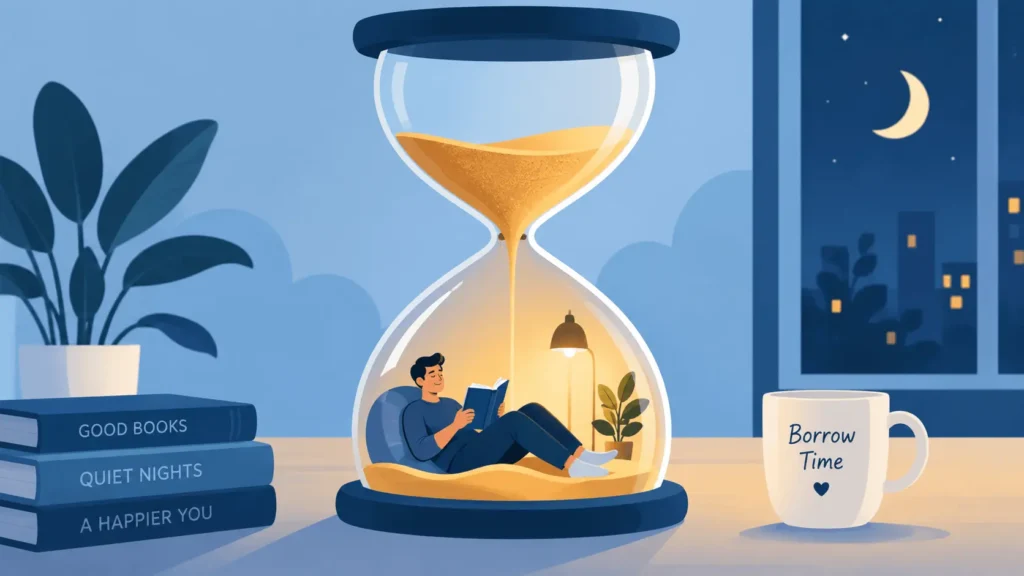
It’s 11:47pm. You’re tired — genuinely, physically tired. Work is done, the house is quiet, nobody needs anything from you. Every rational signal says: go to sleep. And yet you’re still here, watching one more episode, scrolling one more feed, reading one more chapter — fully aware you’ll regret it at 6am, and doing it anyway.
This has a name: revenge bedtime procrastination. It’s the deliberate delay of sleep to reclaim personal time you didn’t feel you had during the day. And here’s the part almost every article about it gets wrong — it’s not really a sleep problem, and it’s not a willpower problem either. It’s what happens when your daytime mental load never got a real outlet, so your brain steals the only unclaimed hours left: the ones after everyone else is asleep.
Why “Just Go to Bed Earlier” Doesn’t Work
Most advice on this topic treats it like a discipline issue — set a bedtime, use less screen time, exercise more willpower. If that worked, you’d have fixed it already. The actual research on this points somewhere different: it’s a *stopping* problem, not a *starting* problem. You’re not failing to start winding down — you’re failing to stop something that feels like the only genuinely yours part of your day.
That distinction matters, because it explains why willpower-based fixes fail so consistently. Telling yourself “I’ll go to bed at 10pm” doesn’t address *why* 10pm feels like giving something up, rather than simply going to sleep.
The Real Cause: An Unpaid Debt From Earlier in the Day
If you’ve read Signs Your Mind Needs a Mental Reset, you already know that mental exhaustion isn’t one thing — it’s usually a mix of sensory, decisional, emotional, and informational load stacking up over the course of a day. Revenge bedtime procrastination is what happens when that load — particularly the decisional and emotional kind — never gets a real release valve during waking hours.
Think about a typical demanding day: dozens of small decisions made on other people’s terms (what the job requires, what the kids need, what the inbox demands), very little of it genuinely chosen. By the time night arrives, there’s an accumulated deficit — not of sleep, but of autonomy. The late hours become the only block of time that feels self-directed, even though sleep is what your body actually needs. You’re not procrastinating on sleep. You’re settling a debt that built up hours earlier.
The Time Debt Illusion
Here’s the trap that keeps this pattern going: those late-night hours *feel* free, but they’re borrowed directly against tomorrow’s capacity. You’re not creating extra personal time — you’re moving it from a future day that hasn’t happened yet, at a worse exchange rate, because tomorrow’s version of you will have less sleep, less patience, and less decisional capacity than tonight’s version does. The math never actually works out; it just feels like it does in the moment, because the cost is deferred and the reward is immediate.
What Actually Helps: Reclaiming Autonomy Earlier, Not Later
Since the root issue is a lack of self-directed time *during the day* — not a lack of information about sleep hygiene — the fix has to happen earlier than 11pm, not at 11pm itself.
Build in genuine micro-autonomy during daylight hours. Even 15-20 minutes of something entirely self-chosen — not squeezed between obligations, not “productive,” just genuinely yours — placed somewhere in the middle of the day measurably reduces the pull toward reclaiming that same feeling at midnight. This doesn’t need to be elaborate; it needs to be real and protected, not something that gets bumped the moment something more “important” comes up.
Reduce decisional load before the evening, not during it. If you’ve read Signs Your Mind Needs a Mental Reset, this will sound familiar — pre-deciding small things earlier in the day (what’s for dinner, what tomorrow’s priorities are) leaves more decisional capacity intact by evening, which reduces the felt need to “escape” decision-making entirely once the day is technically over.
Create a wind-down that still feels chosen, not imposed. A rigid “no screens after 9pm” rule often backfires precisely because it feels like one more obligation dictated by someone else — even when that someone is your own earlier intention. A wind-down routine that includes something genuinely enjoyable (not just screen-free, but actively chosen) tends to hold up better than a purely restrictive one.
Address the notification pull directly. If checking your phone “just once more” is part of the pattern, the Smart Signal Framework in How to Manage Notification Overload is worth applying specifically to your evening hours — the goal isn’t zero phone use at night, it’s reducing how much of that use is reactive versus genuinely chosen.
A Real Example
Daniel, a father of two working a demanding job, realized his 1am scrolling sessions weren’t really about the content he was watching — he barely remembered most of it the next day. His days were almost entirely obligation-driven: work deadlines, school drop-offs, dinner, bedtime routines for the kids. By 10pm, the scrolling wasn’t entertainment, it was the first moment all day that felt like his own choice.
Instead of setting a stricter bedtime (which he’d already tried and failed at repeatedly), he carved out 20 minutes in the early afternoon — genuinely protected, phone-adjacent but not scrolling, just his — to read a few pages of something he actually wanted to read. Within two weeks, his instinct to reclaim time at midnight noticeably weakened. He still occasionally stayed up late, but the compulsive, deliberate “revenge” quality of it faded, because the underlying debt wasn’t accumulating the same way.
What Not to Do
Don’t rely on stricter bedtime rules alone. Without addressing the daytime autonomy deficit, a stricter rule just makes the “revenge” feel more justified, not less necessary.
Don’t eliminate all evening leisure entirely. The goal isn’t to remove personal time at night — it’s to make sure it’s not the *only* personal time you get all day. Some intentional, chosen evening downtime is healthy; the problem is when it’s the sole outlet and it comes at the direct cost of needed sleep.
Don’t treat this as purely a technology problem. Removing screens without addressing the underlying autonomy deficit usually just shifts the behavior (reading too late, tidying at midnight) rather than resolving it.
When to Consider Additional Support
Occasional late nights reclaiming personal time are a normal, low-stakes pattern most people experience sometimes. Consider talking to a healthcare provider if the pattern is severely and consistently disrupting your sleep (most nights, for weeks), if you notice it alongside symptoms of anxiety or depression, or if daytime functioning is significantly impaired as a result. Chronic sleep restriction has real physical and mental health costs, and a professional can help address both the sleep pattern and any underlying contributors more directly than daytime-autonomy adjustments alone.
Frequently Asked Questions
Is this the same as insomnia?
No — this is an important distinction. Insomnia is difficulty falling or staying asleep *despite wanting to*. Revenge bedtime procrastination is a deliberate delay of a bedtime you intended to keep, with nothing physically stopping you from sleeping. If your issue is racing thoughts or an inability to fall asleep once you’re actually in bed, How to Stop Overthinking at Night and Sleep Peacefully addresses that specific pattern rather than this one.
Why does it feel so hard to stop, even when I know I’ll regret it?
Because the reward (a sense of reclaimed control) is immediate, while the cost (next-day exhaustion) is delayed — and the underlying autonomy deficit that’s driving the behavior hasn’t actually been addressed by the thought “I should stop.” That’s why willpower in the moment consistently loses to daytime prevention.
Does this only happen to people with demanding jobs?
No — it shows up in caregivers, parents, students, and anyone whose daytime hours feel heavily dictated by others’ demands, regardless of the specific source. The common thread is a felt lack of autonomy during waking hours, not any one specific type of schedule.
How long does it take to see a difference?
Most people notice some reduction within 1-2 weeks of consistently protecting a real block of daytime autonomy, though full resolution — especially if the pattern has been established for months or years — can take longer and often benefits from also addressing the underlying daily load using the broader approach in Signs Your Mind Needs a Mental Reset.
Is it ever okay to just stay up late on purpose?
Yes — occasionally choosing to stay up for something genuinely worthwhile isn’t the problem. The pattern becomes an issue when it’s compulsive, regretted, happening most nights, and driven by a daytime deficit rather than a genuine, occasional choice.