Quick Answer
Being organized isn’t about having a perfectly tidy home, color-coded planner, or a schedule that never changes. It’s about creating simple systems that help you spend less time searching, forgetting, and feeling overwhelmed. In this guide, you’ll learn the Smart Organization Pyramid, a practical five-level framework that helps you organize your thoughts, time, routines, spaces, and habits so everyday life feels calmer and easier to manage.
At a Glance
Best For
- Busy professionals
- Students
- Parents
- Entrepreneurs
- Remote workers
- Anyone who feels overwhelmed by daily responsibilities
What You’ll Learn
✔ What being organized really means
✔ Why organization feels difficult for many people
✔ The five levels of the Smart Organization Pyramid
✔ A simple step-by-step system to organize your life
✔ How to stay organized without chasing perfection
Take Action Today
Before reading further, look around you and choose one small area you’d like to improve.
It could be:
- Your desk
- Your backpack
- Your inbox
- Your calendar
- Your kitchen counter
Don’t organize it yet.
Simply decide where you’ll start.
That small decision creates momentum.
Table of Contents
- What Does It Really Mean to Be Organized?
- Why Most People Feel Disorganized
- The Smart Organization Pyramid
- A Simple 7-Step Plan to Get Organized
- Common Organization Mistakes
- The Organization Wheel
- Signs You’re Becoming More Organized
- Frequently Asked Questions
- Key Takeaways
- The 7-Day Organization Challenge
Introduction
If you’ve ever looked around your home, opened your inbox, or stared at a long to-do list and thought, “I don’t even know where to start,” you’re not alone.
Many people believe they’re simply “bad at being organized.”
But in most cases, that’s not true.
The problem isn’t a lack of ability.
It’s a lack of simple systems.
Modern life gives us more to manage than ever before.
Appointments.
Passwords.
Emails.
Work projects.
Household responsibilities.
Bills.
Shopping lists.
Digital files.
Personal goals.
Trying to keep track of everything without a clear system can quickly become overwhelming.
That’s why organization isn’t about perfection.
It’s about reducing the number of decisions you have to make every day.
When everything has a place, routines become easier to follow.
When priorities are clear, you spend less time wondering what to do next.
And when your environment supports you instead of distracting you, everyday tasks require less mental effort.
The good news is that becoming more organized doesn’t require expensive planners, complicated apps, or a complete life makeover.
Small, consistent improvements often make the biggest difference.
In this guide, you’ll learn the Smart Organization Pyramid, a practical framework that helps you organize your thoughts, time, systems, spaces, and habits one step at a time.
By the end of this guide, you’ll have a realistic plan for becoming more organized without feeling like you need to change your entire life overnight.
Start Here
If you’re already feeling overwhelmed, don’t try to organize everything today.
Choose one small area instead.
Spend just 15 minutes improving:
- One drawer
- One shelf
- One folder on your computer
- One section of your desk
- One page of your planner
Small wins create momentum.
And momentum makes bigger changes feel possible.
Who This Guide Is For
This guide is designed for anyone who wants a simpler, more organized life without feeling pressured to be perfect.
It will be especially helpful if you:
- Frequently lose important items.
- Forget appointments or deadlines.
- Feel like your to-do list never ends.
- Struggle to keep your home or workspace organized.
- Spend too much time looking for things.
- Feel mentally overwhelmed by everyday responsibilities.
- Want practical systems instead of complicated productivity methods.
Whether you’re managing a busy household, studying at college, working remotely, or balancing multiple responsibilities, the ideas in this guide can be adapted to fit your daily life.
You don’t need to become a naturally organized person overnight.
You simply need better systems than the ones you’re using today.
Who This Guide Is NOT For
This guide may not be the best fit if you’re looking for:
- Professional organizing methods for large businesses or commercial spaces.
- Medical advice related to conditions that may affect organization or executive functioning.
- A one-day transformation that promises to make every part of your life perfectly organized.
Instead, this guide focuses on realistic, sustainable habits that help most people feel more in control of their daily lives.
SmartHelpHub Tip
Being organized isn’t about owning less or doing more. It’s about making everyday decisions easier.
Every simple system you create today becomes one less decision you have to make tomorrow.
Key Insight
Many people think organization begins with buying storage boxes or planners.
In reality, organization begins with clarity.
When you know what matters, where things belong, and what comes next, staying organized becomes much easier.
Real-Life Scenario
Meet Rachel
Rachel works full-time while raising two young children.
Every evening feels chaotic.
She spends ten minutes searching for her keys.
She forgets appointments because they’re written in different places.
Her kitchen counter becomes a temporary storage space for mail, receipts, and school papers.
She isn’t lazy.
She isn’t careless.
She simply doesn’t have simple systems that make daily life easier.
Instead of trying to organize her entire home in one weekend, Rachel starts with one change.
She creates a small tray near the front door where keys, wallets, and sunglasses always go.
Within a week, she stops searching for her keys every morning.
One small system solved one recurring problem.
Over time, those small improvements begin to transform how organized her life feels.
That’s the approach you’ll follow throughout this guide.
Take Action
Before moving to the next section, answer these three questions:
- What frustrates you most about being disorganized?
- Which area of your life feels the most overwhelming right now?
- What’s one small improvement you could make today?
Don’t worry about fixing everything.
Simply identifying your starting point is enough.
What Does It Really Mean to Be Organized?
In Short: Being organized doesn’t mean living in a perfectly tidy home or following a rigid schedule. It means creating simple systems that reduce stress, save time, and help you find what you need when you need it.
Ask ten people what it means to be organized, and you’ll probably hear ten different answers.
Some picture a spotless house.
Others imagine neatly labeled folders, color-coded calendars, or perfectly planned days.
While those things can be helpful, they don’t define organization.
True organization is much simpler.
It’s the ability to manage your responsibilities without constantly feeling overwhelmed.
An organized person isn’t someone who never makes mistakes or whose life always goes according to plan.
They’re someone who has systems that make everyday decisions easier.
For example:
Instead of wondering where their keys are every morning, they always place them in the same location.
Instead of trying to remember appointments, they rely on a calendar.
Instead of keeping important papers in random drawers, they store them in one designated place.
These habits don’t require perfection.
They require consistency.
The goal of organization isn’t to control every moment of your life.
It’s to remove unnecessary friction so you can spend more time focusing on what truly matters.
Organization Is About Reducing Friction
Think about the small frustrations that happen during an ordinary day.
You can’t find your charger.
You forget an appointment.
You spend ten minutes searching for an important document.
You buy something you already own because you couldn’t find it.
Individually, these moments seem minor.
Together, they create unnecessary stress and consume valuable time.
Organization helps reduce these small but frequent obstacles.
Every system you create eliminates a future problem.
For example:
- A dedicated place for your keys prevents daily searching.
- A weekly meal plan reduces last-minute decisions.
- A simple filing system makes important documents easy to locate.
- A shared family calendar prevents missed appointments.
These systems don’t just save time.
They also reduce mental effort.
Organized People Don’t Rely on Memory
One of the biggest myths about organized people is that they simply remember everything.
In reality, they rely on systems instead of memory.
Rather than trying to keep dozens of reminders in their head, they write things down, schedule important tasks, and create routines they can trust.
Memory is useful.
Systems are reliable.
The less you depend on remembering every detail, the more mental energy you have for meaningful work and important decisions.
Organization Creates More Than a Tidy Space
When most people think about organization, they think about physical spaces.
But organization affects much more than your home.
It can improve:
- Your schedule
- Your finances
- Your digital files
- Your daily routines
- Your work
- Your relationships
- Your peace of mind
The real benefit isn’t having cleaner shelves or neater drawers.
It’s feeling less overwhelmed by everyday life.
Real-Life Scenario
Michael’s Morning Rush
Every morning, Michael rushed around the house looking for his wallet, charging cable, and work badge.
He blamed himself for being forgetful.
Eventually, he created a small “launch station” beside the front door with a tray for everyday essentials.
The searching stopped almost immediately.
Michael didn’t suddenly become more organized.
He simply created a system that removed one recurring problem from his day.
That’s the power of practical organization.
SmartHelpHub Tip
Whenever you find yourself repeatedly searching for the same item, ask:
“Could a simple system prevent this from happening again?”
If the answer is yes, you’ve found an opportunity to become more organized.
Organized Thinking vs. Disorganized Thinking
Sometimes the biggest difference isn’t your environment.
It’s your mindset.
Here’s how organized thinking often differs from disorganized thinking.
| Disorganized Thinking | Organized Thinking |
|---|---|
| I’ll remember it later. | I’ll write it down now. |
| I’ll deal with it someday. | I’ll schedule time for it. |
| Everything feels urgent. | I know what’s most important. |
| I’ll put this anywhere. | Everything has a home. |
| I’ll figure it out later. | I follow a simple system. |
Notice that none of these changes require extraordinary effort.
They’re small decisions repeated consistently.
Why Most People Feel Disorganized
In Short: Feeling disorganized is rarely caused by laziness. More often, it happens because modern life demands more attention, decisions, and responsibilities than our brains can comfortably manage without reliable systems.
If you’ve ever wondered,
“Why can’t I stay organized?”
you’re asking a question many people struggle with.
The answer usually isn’t a lack of motivation.
It’s that your brain is trying to manage too much at once.
Let’s explore the most common reasons.
Too Many Responsibilities
Modern life requires us to manage:
- Work
- Family
- Bills
- Emails
- Appointments
- Household chores
- Shopping
- Health
- Personal goals
Each responsibility may seem manageable on its own.
Together, they can feel overwhelming.
Without simple systems, it’s easy to feel like you’re constantly trying to catch up.
Too Many Decisions
Every day involves hundreds of small choices.
What should you wear?
What should you cook?
Which task should you start first?
Should you answer that email now or later?
The more decisions you make, the harder it becomes to think clearly.
Learning how to reduce decision fatigue in daily life can make staying organized much easier because your mental energy is no longer spent on unnecessary choices.
Instead, your systems begin making many of those decisions for you.
Real-Life Scenario
Emma’s Busy Week
Emma kept buying planners, calendars, and organizing apps.
None of them solved her problem.
She wasn’t lacking tools.
She was overwhelmed by constant decisions.
After simplifying her routines and reducing the number of daily choices she had to make, she finally began feeling more organized—even though she owned fewer productivity tools than before.
The solution wasn’t another planner.
It was fewer decisions.
Trying to Organize Everything at Once
One of the most common mistakes people make is attempting to reorganize their entire life in a single weekend.
They create huge to-do lists.
Empty every cupboard.
Rearrange every room.
Download several new apps.
By Sunday evening, they’re exhausted.
By the following week, many of those new systems have already been abandoned.
Real organization happens gradually.
Small improvements last longer than dramatic overhauls.
Comparing Yourself to Others
Social media often shows beautifully organized homes, perfectly planned schedules, and immaculate workspaces.
What it rarely shows is real life.
Your goal isn’t to copy someone else’s system.
Your goal is to create systems that work for your own lifestyle, responsibilities, and priorities.
Practical organization is always more valuable than picture-perfect organization.
Did You Know?
Research in behavioral psychology suggests that people are more likely to maintain habits when those habits are simple, repeatable, and fit naturally into their existing routines.
The same principle applies to organization.
Key Insight
Organization isn’t about becoming a different person.
It’s about making your current life easier to manage.
Simple systems remove unnecessary decisions, reduce stress, and free your attention for the things that matter most.
Take Action
Take a notebook and answer these questions:
- Which part of my life feels the most disorganized?
- What problem happens repeatedly?
- What simple system could reduce that problem?
Don’t try to solve everything today.
Choose one recurring frustration.
That’s where your organization journey should begin.
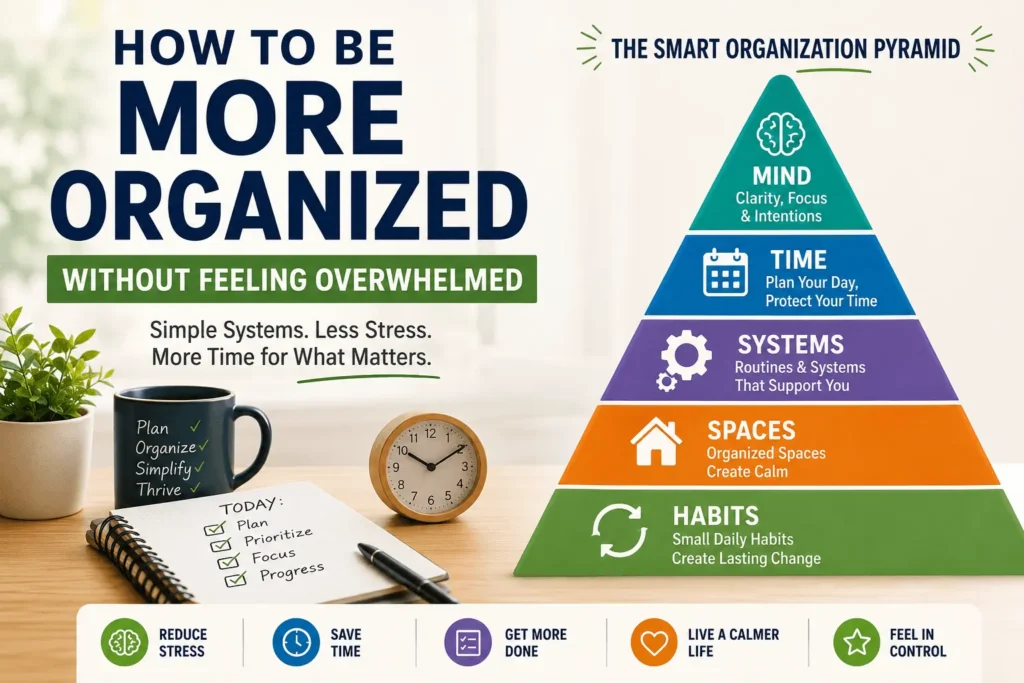
The Smart Organization Pyramid
In Short: Lasting organization doesn’t start with buying storage containers or color-coding your planner. It starts with building a strong foundation. The Smart Organization Pyramid helps you organize your life from the inside out by focusing on your mind, time, systems, spaces, and habits—in that order.
Many people start organizing from the top of the pyramid.
They buy organizers.
Rearrange furniture.
Purchase planners.
Download productivity apps.
Yet after a few weeks, everything slowly returns to the way it was before.
Why?
Because they organized their environment without organizing the systems that support it.
Imagine trying to build a house without a solid foundation.
No matter how beautiful the roof looks, the structure won’t last.
Organization works the same way.
The strongest systems are built from the inside out.
That’s exactly what the Smart Organization Pyramid helps you do.
Instead of trying to fix everything at once, you’ll strengthen one level at a time.
Level 1 — Organize Your Mind
Everything begins with mental clarity.
If your mind is constantly trying to remember appointments, shopping lists, unfinished tasks, passwords, and random ideas, it’s difficult to feel organized.
Trying to remember everything creates unnecessary stress.
Instead of relying on memory, create a habit of capturing information as soon as it appears.
Write things down.
Use a notebook.
Keep one trusted notes app.
Maintain a simple calendar.
Your goal isn’t to remember more.
Your goal is to remember less because your systems are remembering for you.
Building small habits that calm an overstimulated mind can also make it easier to reduce mental clutter and create the space needed for better organization.
Real-Life Scenario
Olivia’s Endless Mental Checklist
Olivia constantly worried she was forgetting something important.
Every evening she mentally reviewed:
- Bills
- School forms
- Grocery items
- Work deadlines
- Birthday reminders
Eventually, she created one master notes system where every idea, reminder, and task was stored.
Within days, she noticed something surprising.
Her mind felt quieter.
She wasn’t more productive because she remembered more.
She was more productive because she stopped trying to remember everything.
SmartHelpHub Tip
If you think,
“I’ll remember that later…”
Write it down immediately.
Your future self will thank you.
Level 2 — Organize Your Time
Once your mind is clearer, the next step is organizing how you spend your time.
Many people begin each day by reacting.
They open email.
Check messages.
Respond to notifications.
Only afterward do they think about their priorities.
Instead, decide what’s important before your day begins.
A simple way to do this is by create a daily to-do list that you’ll actually follow, helping you focus on meaningful work instead of reacting to whatever demands your attention first.
Remember:
A calendar tells you when something happens.
A task list reminds you what needs your attention.
Using both together creates a much more reliable planning system.
Key Insight
An organized day doesn’t happen by accident.
It begins with intentional choices made before distractions take over.
Level 3 — Organize Your Systems
People often believe organized individuals have better self-discipline.
In reality, they usually have better systems.
A system is something you do consistently without having to make the same decision every day.
Examples include:
- Preparing tomorrow’s clothes each evening.
- Paying bills on the same day every month.
- Reviewing your calendar every morning.
- Planning meals every Sunday.
The fewer decisions you repeat unnecessarily, the easier life becomes.
Many people find it helpful to begin with build a simple morning routine that actually works, because a predictable start often leads to a more organized day overall.
Real-Life Scenario
David’s New Routine
David often arrived at work feeling rushed.
Every morning started differently.
Sometimes he packed lunch.
Sometimes he searched for documents.
Sometimes he forgot important items.
He solved the problem by creating a simple evening preparation routine.
Each night he:
- Packed his bag.
- Chose tomorrow’s clothes.
- Checked his calendar.
- Prepared lunch.
His mornings became calmer—not because he woke up earlier, but because his system reduced unnecessary decisions.
Level 4 — Organize Your Spaces
Once your thoughts, schedule, and routines become more organized, it’s much easier to organize your environment.
Notice the order.
Most people start here.
But this is actually the fourth level.
Instead of trying to organize your entire home in one weekend, work one space at a time.
Examples:
- One drawer
- One shelf
- One desk
- One kitchen cabinet
- One closet
Finish one area before starting another.
Small completed projects create confidence.
Half-finished projects create frustration.
One-Space Rule
Whenever you’re organizing:
✔ Choose one space.
✔ Finish it completely.
✔ Return items to their proper homes.
✔ Stop when you’re done.
Avoid jumping between multiple rooms.
Your goal is progress—not exhaustion.
Level 5 — Organize Your Habits
The final level is what keeps everything else working.
Without habits, organization slowly disappears.
You don’t need complicated routines.
Simple habits are enough.
Examples include:
- Returning items after using them.
- Emptying your bag each evening.
- Checking tomorrow’s schedule before bed.
- Clearing your desk before finishing work.
- Spending ten minutes resetting your home at the end of the day.
These small actions prevent clutter from building again.
Did You Know?
Behavior research consistently shows that habits are easier to maintain when they are attached to an existing routine.
For example:
After brushing your teeth…
↓
Review tomorrow’s calendar.
After dinner…
↓
Reset the kitchen.
After finishing work…
↓
Clear your desk.
Small habit pairings are easier to remember than entirely new routines.
The Smart Organization Pyramid at a Glance
| Level | Focus | Daily Action |
|---|---|---|
| 🧠 Mind | Reduce mental clutter | Write things down instead of relying on memory |
| 📅 Time | Plan intentionally | Decide your priorities before the day begins |
| 📂 Systems | Create repeatable routines | Use simple habits that reduce repeated decisions |
| 🏡 Spaces | Organize one area at a time | Finish one space before moving to another |
| 🌱 Habits | Maintain your progress | Spend a few minutes resetting each day |
Common Mistake
Many people organize their spaces before organizing their habits.
The result?
Everything looks great for a few days…
Then slowly returns to its previous state.
Build habits first.
Your spaces will naturally stay organized much longer.
Take Action
Which level of the Smart Organization Pyramid needs the most attention right now?
Choose only one:
☐ Mind
☐ Time
☐ Systems
☐ Spaces
☐ Habits
Spend this week improving that single level before moving on to the next.
Remember:
Strong foundations create lasting results.
A Simple 7-Step Plan to Get Organized
In Short: Getting organized doesn’t require a complete life makeover. By following seven practical steps, you can reduce overwhelm, create reliable systems, and build habits that make staying organized much easier over time.
One of the biggest reasons people give up on organization is because they try to change everything at once.
They spend an entire weekend organizing every room, downloading new apps, buying storage containers, and creating complicated routines.
For a few days, everything looks perfect.
Then life gets busy.
Slowly, the clutter returns.
Instead of trying to transform your entire life overnight, focus on building one small improvement at a time.
These seven steps will help you do exactly that.
Step 1: Choose One Area to Organize
When everything feels messy, it’s tempting to start everywhere.
Resist that temptation.
Instead, choose one specific area.
Examples include:
- Your desk
- One kitchen drawer
- Your backpack
- Your wardrobe
- Your email inbox
- Your bedside table
Completing one area creates momentum.
Starting five areas creates frustration.
Real-Life Scenario
Karen’s Closet
Karen planned to organize her entire house during one weekend.
After spending three hours sorting clothes, she felt exhausted and quit before finishing.
The following weekend, she tried something different.
She focused on one shelf.
It took only twenty minutes.
That small success motivated her to continue the next day.
Within a month, most of her home felt more organized—not because she worked harder, but because she worked more consistently.
Step 2: Remove the Obvious Clutter
Before buying containers or creating labels, remove things you no longer need.
Ask yourself:
- Have I used this recently?
- Does this serve a purpose?
- Would I miss it if it were gone?
You don’t have to become a minimalist.
The goal is simply to reduce unnecessary items that make organization harder.
Less clutter means fewer things to clean, move, organize, and think about.
SmartHelpHub Tip
When deciding whether to keep something, don’t ask:
“Could I use this someday?”
Instead ask:
“Does this improve my life today?”
That small shift often makes decisions much easier.
Step 3: Give Everything a Permanent Home
One of the easiest ways to stay organized is making sure important items always return to the same place.
Think about the things you use every day:
- Keys
- Wallet
- Phone charger
- Work badge
- Headphones
- Important documents
If these items don’t have a permanent home, you’ll probably spend unnecessary time searching for them.
A simple rule is:
If you have to think about where something belongs every time you put it away, your system needs to be simpler.
Key Insight
Organization isn’t about remembering where things are.
It’s about never having to wonder where they belong.
Step 4: Simplify Your Daily Decisions
Every decision uses mental energy.
The more unnecessary decisions you make, the harder it becomes to stay organized.
Examples include:
- Choosing clothes every morning.
- Deciding what to eat each evening.
- Wondering what to work on next.
- Checking every notification as it appears.
Learning to manage notification overload helps reduce one of the biggest sources of unnecessary interruptions, allowing you to focus on the decisions that truly matter.
Whenever possible, make decisions once instead of making them repeatedly.
Simple routines reduce mental effort and create consistency.
Real-Life Scenario
Ahmed’s Evening Routine
Ahmed used to spend every evening deciding what to cook, searching for ingredients, and planning the next day.
Eventually, he created a simple weekly meal plan and packed his lunch before going to bed.
The change saved only a few minutes each day.
But it also removed several small decisions that had been draining his mental energy.
Step 5: Schedule a Weekly Reset
Organization isn’t something you finish.
It’s something you maintain.
Choose one day each week for a short reset.
During this time you can:
- Empty your bag.
- Sort paperwork.
- Clear your desk.
- Check your calendar.
- Plan the week ahead.
Following a regular weekly reset routine helps prevent small amounts of clutter from becoming overwhelming.
Fifteen to twenty minutes each week is often enough.
Weekly Reset Checklist
☐ Clear your workspace
☐ Empty your bag
☐ Review appointments
☐ Remove unnecessary papers
☐ Prepare for next week
Consistency matters more than perfection.
Step 6: Keep Your Digital Life Organized
Physical clutter isn’t the only source of stress.
Digital clutter can be just as overwhelming.
Overflowing downloads folders.
Hundreds of browser tabs.
Unread emails.
Duplicate files.
These small frustrations gradually add unnecessary mental load.
Creating a simple system becomes much easier after you organize your digital life, ensuring your devices support your productivity instead of competing for your attention.
Treat your digital spaces the same way you treat your physical spaces.
Keep them simple.
Keep them intentional.
Did You Know?
Many people spend several hours each year searching for misplaced digital files.
Simple folder structures and regular maintenance can dramatically reduce that wasted time.
Step 7: Review and Improve Every Month
No organization system is perfect forever.
Life changes.
Responsibilities change.
Your systems should change too.
Once each month, ask yourself:
- What’s working well?
- What’s becoming difficult?
- Which routine no longer fits my life?
- What small improvement would make the biggest difference?
Small adjustments prevent your systems from becoming outdated.
Remember, your goal isn’t perfection.
Your goal is creating systems that continue serving your current lifestyle.
The 7-Step Organization Plan at a Glance
| Step | Focus | Action |
|---|---|---|
| 1 | Start Small | Choose one area |
| 2 | Remove Clutter | Keep only what you need |
| 3 | Create Homes | Give important items a permanent place |
| 4 | Simplify Decisions | Reduce unnecessary choices |
| 5 | Weekly Reset | Maintain your systems |
| 6 | Digital Organization | Keep digital spaces organized |
| 7 | Monthly Review | Improve your systems over time |
Common Mistake
Many people believe buying more storage products will solve their organization problems.
Storage can be helpful.
But without simple habits and clear systems, even the best storage solutions eventually become cluttered.
Organize your habits before organizing your containers.
Take Action
Choose one step from this guide and complete it today.
Don’t wait until the weekend.
Don’t wait until you have more time.
Small actions completed today create far more progress than perfect plans postponed until tomorrow.
Common Organization Mistakes That Keep You Feeling Overwhelmed
In Short: Organization isn’t just about what you do right—it’s also about avoiding habits that quietly create clutter, stress, and unnecessary work. Recognizing these common mistakes can help you build systems that actually last.
Many people work hard to become organized.
They buy planners.
Watch organizing videos.
Spend entire weekends cleaning.
Yet a few weeks later, they feel like they’re back where they started.
The problem usually isn’t motivation.
It’s relying on short-term effort instead of long-term systems.
Let’s look at the most common mistakes and how to avoid them.
Mistake 1: Trying to Organize Everything at Once
This is the biggest mistake of all.
When your life feels chaotic, it’s tempting to fix everything in one day.
You might decide to:
- Clean every room.
- Organize every drawer.
- Sort every document.
- Rearrange your office.
- Empty your wardrobe.
By the end of the day, you’re exhausted.
And because the project felt so overwhelming, you don’t want to do it again.
A Better Approach
Organize one area.
Finish it.
Celebrate the progress.
Then move to the next.
Small completed projects build confidence.
Large unfinished projects create frustration.
Real-Life Scenario
Sarah’s Saturday Plan
Sarah blocked out an entire Saturday to organize her house.
She started in the kitchen.
Then moved to the bedroom.
Then the garage.
Then the office.
By evening, four rooms were half-finished.
Instead of feeling accomplished, she felt discouraged.
The following weekend, she focused only on one kitchen cabinet.
It took twenty minutes.
She finished it completely.
That small success motivated her to continue.
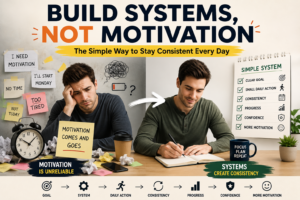
Mistake 2: Depending on Motivation
Many people believe they’ll become organized once they feel motivated.
The problem?
Motivation changes every day.
Some mornings you’ll feel energized.
Other days you’ll feel tired.
Systems continue working even when motivation disappears.
A Better Approach
Build routines that are simple enough to follow even on busy days.
Consistency always beats occasional motivation.
SmartHelpHub Tip
Ask yourself:
“Could I maintain this routine on my busiest day?”
If the answer is no, simplify it.
Simple systems last longer.
Mistake 3: Buying Storage Before Creating Systems
It’s easy to believe another storage box or organizer will solve the problem.
Sometimes it helps.
Often it doesn’t.
Storage organizes belongings.
It doesn’t organize habits.
Without a clear system, even beautifully labeled containers eventually become cluttered.
A Better Approach
Decide:
- What you’re keeping.
- Where it belongs.
- How you’ll maintain it.
Only then think about storage.
Mistake 4: Relying on Memory
Trying to remember everything creates unnecessary mental pressure.
Appointments.
Birthdays.
Passwords.
Shopping lists.
Work deadlines.
Important documents.
Eventually something gets forgotten.
A Better Approach
Create one trusted place for information.
Write it down.
Use a calendar.
Keep checklists.
Build systems your future self can rely on.
Key Insight
Every reminder you write down is one less thing your brain has to carry.
Organization creates mental space—not just physical space.
Mistake 5: Letting Small Messes Grow
Clutter rarely appears overnight.
It builds gradually.
One receipt.
One jacket.
One unread email.
One extra browser tab.
One pile of paperwork.
Eventually those small items become overwhelming.
A Better Approach
Spend five to ten minutes each day putting things back where they belong.
Tiny resets prevent major cleanups.
Did You Know?
Behavior experts often describe habits as easier to maintain when they take only a few minutes. A short daily reset is usually much more sustainable than waiting for a full day of cleaning.
Mistake 6: Constantly Interrupting Yourself
Sometimes disorganization isn’t caused by clutter.
It’s caused by losing focus before finishing simple tasks.
For example:
You begin organizing a drawer.
A phone notification appears.
You check it.
Then open social media.
Then answer a message.
Twenty minutes later, the drawer is still unfinished.
Learning to stop checking your phone every few minutes can help reduce these unnecessary interruptions, making it easier to complete one task before moving on to the next.
Organization and attention work together.
The better you protect your focus, the easier it becomes to stay organized.
Common Mistake
Don’t confuse being busy with being organized.
A full schedule doesn’t automatically mean your life is well organized.
The goal is clarity—not constant activity.
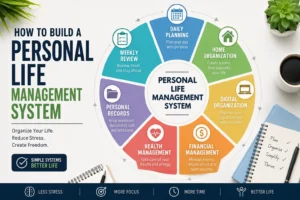
The Organization Wheel
In Short: Before improving your organization, it’s helpful to understand which areas of your life need the most attention. The Organization Wheel gives you a simple way to identify your strengths and priorities.
Rate yourself from 1 (Needs Improvement) to 5 (Excellent) in each area.
| Area | Your Score (1–5) |
|---|---|
| 🧠 Mental Organization | ☐ |
| 📅 Time & Schedule | ☐ |
| 🏡 Home Organization | ☐ |
| 💻 Digital Organization | ☐ |
| 📄 Paperwork & Documents | ☐ |
| 💰 Financial Organization | ☐ |
| 🎒 Daily Essentials | ☐ |
| ❤️ Personal Well-being | ☐ |
Don’t worry about getting high scores everywhere.
Instead, look for your lowest two scores.
Those are your biggest opportunities for improvement.
How to Use the Organization Wheel
After scoring yourself, ask:
- Which area creates the most stress?
- Which improvement would make everyday life easier?
- Which area can I realistically improve this month?
Avoid trying to improve all eight areas at once.
Choose one.
Focus on it.
Build confidence.
Then move to the next.
That’s how lasting organization develops.
Quick Self-Assessment
Answer Yes or No to these questions:
☐ I usually know where important items are.
☐ My calendar is up to date.
☐ I rarely lose things.
☐ My workspace helps me stay productive.
☐ I have a simple weekly reset routine.
☐ I spend very little time searching for items.
☐ I feel in control of my daily responsibilities.
If you answered “No” several times, don’t be discouraged.
Each “No” simply highlights an area where a small system could make life easier.
Take Action
Complete your Organization Wheel today.
Choose the lowest-scoring area and write down one small action you’ll take this week.
Examples:
- Create a folder for important documents.
- Clear one drawer.
- Update your calendar.
- Set up a place for your keys.
- Organize your workspace.
One small improvement is enough.
Progress grows through consistency—not perfection.
Signs You’re Becoming More Organized
In Short: Becoming more organized doesn’t happen overnight. Most improvements are small at first, but they gradually make everyday life feel calmer, simpler, and more manageable.
Many people expect organization to create dramatic changes immediately.
They imagine waking up one day with a perfectly tidy home, a flawless schedule, and complete control over every responsibility.
Real life doesn’t work that way.
Organization is usually built through small improvements that become noticeable over time.
Instead of asking,
“Am I perfectly organized?”
Ask,
“Is my life becoming easier to manage?”
If the answer is yes, you’re making progress.
Let’s look at some of the clearest signs.
1. You Spend Less Time Looking for Things
One of the earliest signs of better organization is surprisingly simple.
You stop asking questions like:
- “Where are my keys?”
- “Where did I put that document?”
- “Which folder did I save that file in?”
Because everything has a designated place, you spend less time searching and more time getting things done.
Even saving five minutes each day adds up to hours over the course of a year.
Real-Life Scenario
Daniel’s Morning Routine
Daniel used to spend nearly ten minutes every morning looking for everyday essentials.
His wallet might be on the kitchen counter.
His work badge could be in yesterday’s jacket.
His headphones were wherever he last used them.
After creating a simple entryway station, those daily searches disappeared.
Nothing about his schedule changed.
His system did.
2. Your Home Feels Calmer
An organized home doesn’t have to look like a magazine.
It simply feels easier to live in.
You know where things belong.
Surfaces stay clearer.
Cleaning becomes faster.
Unexpected guests no longer create unnecessary stress.
The goal isn’t perfection.
The goal is reducing daily friction.
Key Insight
A calm home isn’t created by constantly cleaning.
It’s created by giving everything a place and returning it there consistently.
3. You Forget Fewer Important Tasks
Organization reduces the number of things you have to remember.
Instead of relying on memory, you trust your systems.
Appointments are in your calendar.
Bills are scheduled.
Shopping lists are written down.
Important documents have one reliable location.
This frees your mind to focus on more meaningful work instead of worrying about forgetting something.
4. You Make Decisions More Easily
When your systems are clear, many daily decisions disappear.
You no longer wonder:
- What should I work on first?
- Where should I put this?
- What needs my attention today?
Your routines answer those questions for you.
Less decision-making means more mental energy for important work.
Did You Know?
Many people report feeling less mentally exhausted after improving their organization—not because they have fewer responsibilities, but because they spend less energy making the same decisions over and over.
5. Your Workspace Supports You
Whether you work from home, study at school, or manage household responsibilities, your environment begins working with you instead of against you.
You can find what you need quickly.
Your desk feels less distracting.
Important materials are easy to access.
This doesn’t just improve productivity.
It also reduces frustration.
6. You Feel More in Control of Your Day
Perhaps the biggest sign of all is emotional rather than physical.
Instead of feeling like you’re constantly reacting to problems, you begin responding with confidence.
Unexpected situations still happen.
Plans still change.
But because your systems are stronger, those interruptions no longer throw your entire day off track.
That’s real progress.
Weekly Organization Check-In
Take five minutes at the end of each week and ask yourself:
☐ Did I know where my important items were?
☐ Did I complete my highest-priority tasks?
☐ Did my systems save me time?
☐ Did I feel less overwhelmed than last week?
☐ Which habit helped me the most?
☐ What should I improve next week?
Don’t aim for perfect scores.
Look for gradual improvement.
Progress Is Better Than Perfection
One of the biggest mistakes people make is expecting permanent organization.
Life changes.
New responsibilities appear.
Children grow.
Jobs change.
Schedules become busier.
Organization isn’t something you achieve once.
It’s something you adjust as your life evolves.
The good news is that every small system you build makes those future adjustments easier.
SmartHelpHub Tip
Instead of asking:
“How can I organize my whole life?”
Try asking:
“What’s one small thing I can make easier today?”
That question keeps organization practical and sustainable.
Organization Is a Skill, Not a Personality Trait
Some people believe they’re simply “not organized.”
That’s rarely true.
Organization isn’t something you’re born with.
It’s a collection of skills that anyone can learn.
Every habit you build.
Every routine you simplify.
Every system you improve.
Moves you one step closer to a calmer, more manageable life.
Progress may feel slow at times.
But small improvements repeated consistently almost always outperform dramatic changes that are difficult to maintain.
Common Mistake
Don’t compare your progress to someone else’s highlight reel.
Social media often shows the finished result—not the years of habits and routines that made it possible.
Measure your progress against where you were last month, not where someone else appears to be today.
Take Action
Take a few minutes today and write down three ways you’re already more organized than you were six months ago.
They don’t have to be major achievements.
Maybe you:
- Use a calendar consistently.
- Lose your keys less often.
- Keep your workspace tidier.
- Plan your week in advance.
Recognizing your progress builds motivation and reminds you that lasting organization happens one small step at a time.
Frequently Asked Questions
What does it mean to be organized?
Being organized means having simple systems that help you manage your time, responsibilities, and belongings more efficiently. It’s less about having a perfectly tidy home and more about reducing stress, avoiding unnecessary confusion, and making daily life easier.
Why do I always feel disorganized?
Many people feel disorganized because they’re trying to manage too many responsibilities without reliable systems. Constant decisions, digital distractions, busy schedules, and relying on memory instead of routines can all contribute to feeling overwhelmed.
The good news is that organization is a skill that can be learned and improved over time.
Can anyone become more organized?
Yes.
Organization isn’t a personality trait—it’s a collection of habits and systems. Small improvements, such as using a calendar, creating routines, and giving everyday items a permanent home, can make a noticeable difference regardless of your starting point.
What’s the first thing I should organize?
Start with the area that causes you the most daily frustration.
For many people, this might be:
Their workspace
Their calendar
Their kitchen counter
Their email inbox
Their daily essentials
Starting small builds confidence and creates momentum.
How long does it take to become organized?
There’s no fixed timeline.
Some improvements, such as creating a dedicated place for your keys or organizing your desk, can make an immediate difference.
Developing long-term organization habits usually takes consistent practice over several weeks or months.
The important thing is steady progress—not speed.
Can organization reduce stress?
Yes.
When you know where things belong, have clear priorities, and rely on simple systems, everyday tasks require less mental effort.
While organization won’t eliminate every source of stress, it can reduce the unnecessary stress caused by clutter, forgotten tasks, and constant searching.
Do I need expensive planners or organizing products?
No.
Many effective organization systems require little or no money.
A notebook, a simple calendar, and a few consistent routines are often more valuable than buying new storage products without a clear plan.
Focus on creating systems first.
Products should support those systems—not replace them.
Key Takeaways
If you remember only a few ideas from this guide, let them be these:
- Organization is about creating simple systems, not achieving perfection.
- Small improvements are easier to maintain than major overhauls.
- The Smart Organization Pyramid helps you build lasting organization from the inside out.
- Consistency matters more than motivation.
- Organizing one area at a time creates sustainable progress.
- Daily and weekly habits prevent clutter from returning.
- Your systems should make life easier—not more complicated.
Most importantly:
You don’t need to organize your entire life today. You only need to improve one small part of it.
Final Thoughts
It’s easy to believe that organized people simply have more time, better discipline, or naturally tidy personalities.
In reality, most organized people have something much simpler.
They have systems.
Small routines.
Clear priorities.
Reliable places for important things.
Those systems quietly remove dozens of tiny frustrations every day.
You don’t have to transform your life overnight to experience the same benefits.
Choose one drawer.
One routine.
One calendar.
One workspace.
One habit.
Improve that first.
Then build from there.
Over time, those small improvements create something much bigger.
A life that feels calmer.
More predictable.
Less stressful.
And easier to manage.
Organization isn’t about becoming someone different.
It’s about creating a life that works better for the person you already are.
The 7-Day Organization Challenge
Ready to put these ideas into practice?
Spend the next seven days making one small improvement each day.
Day 1
Choose one area that causes you the most frustration.
Spend 15 minutes organizing it.
Day 2
Create a permanent home for three everyday items you often misplace.
Examples:
- Keys
- Wallet
- Charger
Day 3
Write tomorrow’s three most important tasks before going to bed.
Day 4
Clear one digital space.
Examples:
- Downloads folder
- Desktop
- Email inbox
- Phone home screen
Day 5
Create one simple routine you’ll repeat every day.
It could be:
- Five-minute desk reset
- Evening calendar check
- Morning planning session
Day 6
Complete a 15-minute weekly reset.
Review:
- Calendar
- Workspace
- Important papers
- Upcoming priorities
Day 7
Reflect on your progress.
Ask yourself:
- What was the easiest habit to maintain?
- Which system saved me the most time?
- What should I continue next week?
Remember:
Small improvements become lasting habits when they’re repeated consistently.
Weekly Success Checklist
By the end of the challenge, ask yourself:
☐ I know where my important items are.
☐ My schedule feels more organized.
☐ I spend less time searching for things.
☐ My workspace feels calmer.
☐ My digital spaces are easier to manage.
☐ I feel less overwhelmed.
☐ I have at least one new habit I can continue.
If you checked most of these boxes, you’ve already made meaningful progress.
SmartHelpHub Tip
Don’t ask, “How can I organize everything?” Ask, “What’s one thing I can make easier today?” That simple question turns organization into a habit instead of a burden.