
You finished the day with fourteen things checked off, three meetings attended, and forty emails answered — and you couldn’t tell anyone what you actually accomplished. Busy, but not productive. If that pattern feels familiar, you’re not alone, and you’re also not imagining that something about the “do more, faster” model of productivity has stopped working. A real shift is underway, and it has a name: slow productivity.
What Slow Productivity Actually Means
The term comes from computer science professor and author Cal Newport, who describes it as a way of working built on doing fewer things, working at a natural and sustainable pace, and caring more about the quality of what you produce than the volume. It’s a direct response to what he calls “pseudo-productivity” — measuring your worth by how visibly busy you appear, rather than by what you actually finish and how well you finish it.
This isn’t about doing less work in some vague, aspirational sense. It’s a specific correction to a specific problem: task lists and calendars that reward volume and visible activity, even when that volume produces worse results and burns people out in the process.
Why This Is Gaining Real Traction Now
The timing isn’t random. After several years of “always-on” work culture, burnout has become common enough that recovering from it has become its own widely searched topic. Productivity commentary in 2026 has increasingly landed on the same conclusion from a different direction: rest and pacing aren’t the opposite of productivity, they’re a precondition for it. No system, tool, or app can compensate for someone running on chronic depletion — and slow productivity is essentially the mainstream articulation of that idea.
The Real Problem: “More” Became the Default Answer
Somewhere along the way, “add more” became the automatic response to almost any productivity problem: more tools, more categories, more hours, more tasks tracked. This mirrors exactly the pattern covered in Signs Your Mind Needs a Mental Reset — informational and decisional load stacking endlessly, because nothing in the system ever asks “should this be here at all,” only “how do I fit this in too.”
Slow productivity flips that default. Instead of asking how to fit more in, it asks what can be removed, so the things that remain get real attention instead of divided, exhausted attention spread across too much at once.
A Practical System for Actually Doing This
Understanding the philosophy is easy. Implementing it without just feeling vaguely guilty about being “too busy” is the harder part. Here’s a concrete way to apply it, built around three shifts:
Shift 1: Fewer, Chosen Deliberately
Rather than working from an ever-growing task list, pick a genuinely small number of priorities — real proponents of this approach often suggest as few as three meaningful things at a time, not per day, but as your active focus overall. Everything else waits, gets delegated, or gets dropped entirely. This is uncomfortable at first, because it requires actually deciding what doesn’t matter enough right now, rather than deferring that decision indefinitely by tracking everything “just in case.”
If your current system is a long, undifferentiated to-do list, How to Create a Daily To-Do List That Actually Works is a useful starting point for restructuring it around fewer, clearer priorities rather than a longer, more exhausting one.
Shift 2: A Sustainable, Natural Pace
Slow productivity explicitly rejects the idea that pace should stay at maximum intensity indefinitely. A natural pace includes real variation — periods of focused intensity followed by genuine recovery, rather than a flat, unsustainable sprint stretched across months.
This is where a structured tool actually helps rather than just adding more to track. The Daily Focus Timer is built around exactly this idea — defined, focused sessions followed by real breaks, rather than an undifferentiated block of “work time” that quietly erodes in quality the longer it stretches on without a genuine pause.
Shift 3: Obsess Over Quality, Not Volume
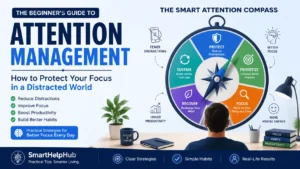
The final shift is a genuine mindset change: judging a day by the depth and quality of what got done, not the number of items checked off. This connects directly to the “Focus Deeply” pillar of the Smart Attention Compass — single-tasking on fewer things produces work worth actually finishing well, rather than many things finished just well enough to move on.
How to Start This Week
You don’t need to overhaul your entire schedule to begin. Pick one current project or responsibility and apply all three shifts to it specifically: narrow it to one clear outcome, give it a defined focused session rather than scattered attention throughout the day, and resist the urge to add anything else to it until that one thing is genuinely done well. Notice how it feels different from your usual pace before deciding whether to expand the approach further.
A Real Example
Jordan, a freelance consultant, had been running six client projects simultaneously, none of them getting his full attention, all of them technically “in progress” for weeks. Switching to slow productivity didn’t mean taking on fewer clients overall — it meant working on two projects at a time with real depth, finishing them well, then moving to the next two, rather than shallow, divided attention spread across all six constantly.
Total output over a month looked similar on paper. The quality — and his own sense of actually finishing things rather than perpetually juggling — was meaningfully different.
What Slow Productivity Is Not
It’s not laziness or doing less work overall. The “slow” refers to pace and intentionality, not to output — Newport himself points to historically prolific figures who worked this way, producing substantial bodies of work over sustainable timelines rather than through constant sprinting.
It’s not a luxury only available to people with total schedule flexibility. The three shifts above can apply within a demanding job or a full schedule — narrowing focus, protecting genuine breaks, and prioritizing depth over checking boxes are choices available at almost any pace of life, even if the specific tactics need adapting.
It’s not the same as chronic procrastination. Deliberately choosing fewer priorities and a sustainable pace is different from avoiding things — the former is a considered choice about where attention goes, the latter is avoidance dressed up as a philosophy.
Frequently Asked Questions
Will doing fewer things actually hurt my output or career?
The core claim of slow productivity is the opposite — that divided, exhausted attention across many things produces worse results than focused attention on fewer things, even though it feels more “productive” in the moment. Output measured by genuine completion and quality, rather than visible busyness, is the more accurate metric.
How is this different from just being disorganized?
Genuine slow productivity is deliberate and structured — fewer priorities chosen on purpose, paced work sessions, real breaks — rather than an absence of structure. Disorganization is the lack of any system; slow productivity is a specific, intentional system.
Can I apply this in a traditional job with fixed hours and deadlines?
Yes, though the tactics adapt — you may not control your total workload, but you can often control how you sequence and focus on what’s assigned, protecting depth on your highest-priority tasks even within a structured schedule.
What if my workplace culture rewards visible busyness, not quiet depth?
This is a genuine tension worth acknowledging rather than dismissing. Start with what’s within your control — your own pacing and focus within tasks — even if you can’t change how visible busyness is rewarded around you. Small, consistent quality improvements tend to be noticed over time even in busyness-oriented cultures.
How long does it take to feel a real difference?
Most people notice a shift in how work feels within 1-2 weeks of genuinely narrowing focus and protecting real breaks, though changing deeply ingrained “more is better” habits fully can take longer — treat it as an ongoing recalibration, not a one-time switch.